
Let’s be honest — most small business owners didn’t start their journey thinking about Instagram grids, content calendars, or Facebook ad funnels. You started because you had a skill, a product, or a vision worth sharing with the world. But somewhere along the way, you realized: if people can’t find you online, you might as well not exist.
That’s exactly where a solid social media marketing strategy for small businesses changes everything.
Social media isn’t just about posting pretty pictures anymore. In 2026, it’s a full-blown business engine — one that drives brand awareness, generates leads, builds customer loyalty, and yes, directly impacts revenue. Whether you’re running a boutique in Berlin, a consulting firm in Delhi, a bakery in Lagos, or an online store from your bedroom in Manila — the rules of the game are the same, and they’re learnable.
This guide is your complete, no-fluff, step-by-step roadmap. We’ll cover everything from defining your goals and choosing the right platforms, to building a content strategy, running paid ads, and using AI automation to work smarter. By the end, you’ll have a clear, actionable plan you can actually execute — with or without a big marketing budget.
Let’s get into it.
What Is Social Media Marketing for Small Businesses?
Social media marketing, at its core, is the practice of using social platforms like Instagram, Facebook, LinkedIn, TikTok, X (formerly Twitter), Pinterest, and YouTube to promote your business, connect with your audience, and drive meaningful business outcomes.
For small businesses specifically, social media marketing serves a slightly different purpose than it does for large corporations. You’re not trying to reach 10 million people. You’re trying to reach the right people — your ideal customers, in the right place, at the right time, with the right message.
In simple terms, it involves:
- Creating and publishing content that informs, entertains, or inspires your audience
- Engaging with followers through comments, DMs, polls, and stories
- Running paid ads to amplify your reach beyond organic limits
- Analyzing performance data to continuously improve results
- Building a consistent brand voice that people recognize and trust
The beauty of social media marketing for small businesses is that you don’t need a massive budget to make a real impact. What you do need is strategy, consistency, and a genuine understanding of your audience.
Why Global Social Media Strategy Matters for Small Brands
Here’s a mindset shift that every small business owner needs to make: the internet has no borders.
A decade ago, if you ran a small business, your market was largely defined by your geography. Today, a handmade jewellery seller in Jaipur can ship to customers in London. A fitness coach in Nairobi can run online classes for clients in Toronto. A SaaS startup in Bangalore can sell subscriptions to businesses in Brazil.
This is exactly why a global social media marketing strategy isn’t just for Fortune 500 companies. It’s for anyone who wants to grow beyond their local neighbourhood.
Here’s why going global with your social media strategy matters:
- Expanded market reach: Platforms like Instagram and TikTok have truly global audiences. A single viral post can introduce your brand to thousands of new potential customers overnight.
- Diverse revenue streams: Depending on a single local market is risky. A global online presence creates multiple income opportunities.
- Brand credibility: Being visible internationally signals that your brand is established and trustworthy, even if you’re a one-person operation.
- Cost-efficient advertising: With Meta Ads and Google Ads, you can target specific countries, cities, languages, and demographics for as little as $5–$10 per day.
- Competitive advantage: Most of your local competitors are probably not thinking globally yet. This is your window.
The key is to build a social media strategy for small business that is simultaneously globally scalable and locally relevant. We’ll show you exactly how to do that.

Define Your Business Goals and Social Media KPIs
Before you post a single piece of content, you need to answer one critical question: What do I actually want social media to do for my business?
This sounds obvious, but you’d be surprised how many small businesses skip this step entirely. They start posting because they feel they “should be on social media” — without any clear direction. The result? Inconsistent content, zero measurable results, and eventual burnout.
Your social media goals should always connect back to real business objectives. Here’s how that mapping looks in practice:
| Business Goal | Social Media Goal | Key KPI |
|---|---|---|
| Increase sales | Drive traffic to product pages | Click-through rate, conversions |
| Build brand awareness | Grow reach and impressions | Follower growth, reach, shares |
| Generate leads | Collect emails / DM inquiries | Lead form submissions, DMs |
| Build customer loyalty | Improve engagement and community | Comments, saves, repeat visits |
| Establish authority | Grow thought leadership | Shares, mentions, website traffic |
Once you know your goals, define your social media KPIs for small business growth. These are the specific, measurable numbers you’ll track each month. Common KPIs include:
- Reach & Impressions — how many people see your content
- Engagement Rate — likes, comments, shares, and saves as a percentage of reach
- Follower Growth Rate — how quickly your audience is expanding
- Click-Through Rate (CTR) — how often people click your links
- Conversion Rate — how many social media visitors take a desired action
- Cost Per Lead / Cost Per Click — for paid campaigns
Pro tip: Use the SMART framework. Your goals should be Specific, Measurable, Achievable, Relevant, and Time-bound. For example: “Grow Instagram followers from 500 to 2,000 in 90 days through consistent Reels and hashtag strategy.” That’s a goal you can actually work toward.
Identify Your Target Audience in Global Markets
You cannot market to everyone. Trying to appeal to everyone means you’re compelling to no one.
Defining your target audience is one of the most important — and most underrated — parts of building a social media plan for small business. When you know exactly who you’re talking to, your content becomes sharper, your messaging becomes more powerful, and your ad spend becomes far more efficient.
Here’s how to build a clear picture of your ideal customer:
Step 1: Create a Customer Persona
Give your ideal customer a name, an age range, a job title, and a lifestyle. For example:
“Priya, 28, a working professional in Mumbai who runs a side business selling handmade skincare products. She’s active on Instagram and Pinterest, cares about sustainability, and is looking for affordable ways to market her brand online.”
Step 2: Understand Their Pain Points
What problems are they trying to solve? What keeps them up at night? What do they search for on Google? Your content and messaging should speak directly to these frustrations.
Step 3: Know Where They Hang Out Online
Different audiences live on different platforms. A B2B audience is likely on LinkedIn. Gen Z consumers are on TikTok and Instagram Reels. A professional services audience might be more active on YouTube and Twitter/X.
Step 4: Research Globally, But Segment Locally
If you’re targeting global markets, use Meta’s Audience Insights, Google Analytics, and platform analytics to understand the demographics of your current followers. Look for patterns — which countries are engaging with you? What age groups are converting?
For businesses targeting international audiences, consider creating separate content pillars or even separate accounts for significantly different regions. Cultural nuance matters enormously in social media marketing.
Choose the Best Social Media Platforms for Small Businesses
One of the biggest mistakes small business owners make is trying to be everywhere at once. You don’t need to be on every platform. You need to be on the right platforms — the ones where your target audience actually spends their time.

Here’s a practical breakdown of the best social media platforms for small businesses globally:
Best for: Products, lifestyle brands, fashion, food, beauty, travel, services Why it works: Visual storytelling, Reels for organic reach, Stories for engagement, Shopping features for e-commerce. Highly global with strong audiences in Asia, Europe, and the Americas.
Best for: Local businesses, service providers, B2C brands targeting 30–55 age groups Why it works: The largest social network globally, Facebook Groups create community, and Meta Ads offer the most powerful targeting available in digital advertising.
Best for: B2B businesses, consultants, agencies, professional services, SaaS Why it works: Professional audience, high trust environment, strong for thought leadership content, and excellent for lead generation in B2B markets.
TikTok
Best for: Brands targeting Gen Z and Millennials, entertainment-driven businesses, education, and e-commerce Why it works: Unmatched organic reach for new accounts, viral potential, global audiences across 150+ countries.
YouTube
Best for: Education, how-to content, product demonstrations, long-form storytelling Why it works: Second largest search engine in the world. Great for SEO, long-term organic traffic, and building deep authority.
Best for: Home decor, weddings, recipes, fashion, DIY, travel Why it works: High purchase intent audience, strong in US, UK, and Europe, excellent for driving e-commerce traffic.
X (Twitter)
Best for: Tech brands, news, commentary, personal branding Why it works: Real-time conversations, trending topics, useful for brand personality and PR.
Our recommendation: Start with 2–3 platforms maximum. Master them before expanding. For most small businesses, Instagram + Facebook is the ideal starting point. If you’re B2B, replace Facebook with LinkedIn.
Build a Strong Brand Presence and Content Style Guide
Your social media presence is your brand’s digital storefront. Before a potential customer ever visits your website or calls your phone number, they’ve already formed an impression of you based on your social media profiles.
A strong, consistent brand presence isn’t just about looking professional. It’s about being recognizable, trustworthy, and memorable.
Here’s what your brand presence should include:
Profile Optimization Checklist:
- ✅ Clear, high-quality profile photo (logo or professional headshot)
- ✅ Compelling bio that explains what you do, who you help, and includes a CTA
- ✅ Website link or Linktree with all key links
- ✅ Consistent handle/username across all platforms
- ✅ Highlighted Stories (for Instagram) with key categories: About Us, Services, Testimonials, FAQs
Content Style Guide Essentials:
- Brand Colors: Choose 2–3 primary colors and use them consistently across all content
- Typography: Select 1–2 fonts that reflect your brand personality
- Tone of Voice: Are you friendly and casual? Professional and authoritative? Witty and bold? Define it and stick to it.
- Visual Style: Will your feed be bright and minimal? Dark and moody? Colorful and vibrant? Consistent visuals build instant recognition.
- Content Mix: Define your content pillars (more on this in the next section)
Think of brands you follow and trust on Instagram or LinkedIn. What makes them feel cohesive and credible? It’s almost always consistency. The caption style feels the same, the visuals feel familiar, the messaging is clear. That’s what you’re building.
Step-by-Step Social Media Content Strategy for Small Businesses
Now we’re getting to the heart of it. Content is what makes everything work. A brilliant strategy with mediocre content will fail. But great content, guided by a clear strategy, is unstoppable.
Here’s how to build a social media content strategy for small businesses from scratch:
Step 1: Define Your Content Pillars
Content pillars are the core themes your content consistently revolves around. Most small businesses should have 4–5 pillars. For example, a digital marketing agency might use:
- Educational Content — tips, tutorials, how-to guides
- Behind-the-Scenes — showing the human side of the business
- Client Results & Social Proof — case studies, testimonials, before/after
- Promotional Content — services, offers, announcements
- Engagement Content — polls, questions, trending topics
Step 2: Plan Your Content Formats
Different formats serve different goals:
- Reels / Short Videos — maximum organic reach, great for awareness
- Carousels — high engagement, excellent for education and storytelling
- Static Posts — brand consistency, announcements
- Stories — daily engagement, behind-the-scenes, polls
- Long-form Video (YouTube/Facebook) — trust building, deep authority
- Live Sessions — community building, Q&As, launches
Step 3: Follow the 80/20 Rule
80% of your content should provide genuine value — educate, entertain, inspire, or solve a problem. Only 20% should be directly promotional. Audiences don’t follow businesses that constantly sell to them. They follow accounts that consistently add value.
Step 4: Batch Create and Schedule Content
Trying to create content every day in real-time is exhausting and inconsistent. Instead, dedicate one day per week (or 2–3 days per month) to batch-creating content in advance. Use tools like Buffer, Later, or Hootsuite to schedule posts.

Create a Monthly Social Media Content Calendar (With Examples)
A social media content calendar for small business is your best friend. It removes the daily stress of “what do I post today?” and ensures your content strategy stays on track consistently.
Here’s a simple one-week example for a service-based small business:
| Day | Platform | Format | Content Pillar | Example Topic |
|---|---|---|---|---|
| Monday | Carousel | Educational | “5 Reasons Your Business Isn’t Growing on Instagram” | |
| Tuesday | Static Post | Social Proof | Client testimonial with results screenshot | |
| Wednesday | Reel | Behind-the-Scenes | A day in the life at [your business name] | |
| Thursday | Article/Post | Thought Leadership | “Why Small Businesses Are Winning with AI Automation” | |
| Friday | Story Poll | Engagement | “Which type of content do you find most helpful?” | |
| Saturday | Promotional | Offer/Service | Weekend special or service spotlight | |
| Sunday | Motivational | Brand Values | Inspirational quote related to entrepreneurship |
Monthly Planning Tips:
- Plan content themes around holidays, awareness days, and local/global events
- Build a library of evergreen content you can repost and repurpose
- Leave 20% of your calendar flexible for trending/reactive content
- Review the previous month’s top-performing posts and create more of what worked
How to Use Hashtags and Keywords for Global Reach
Hashtags and keywords are your discovery tools. Used correctly, they put your content in front of people who’ve never heard of you but are actively searching for what you offer.
Instagram & TikTok Hashtag Strategy:
- Use a mix of broad, niche, and branded hashtags
- Broad hashtags (1M+ posts): e.g., #SmallBusiness, #DigitalMarketing
- Mid-tier hashtags (50K–500K posts): e.g., #SmallBusinessTips, #SocialMediaStrategy
- Niche hashtags (under 50K posts): e.g., #BakeryDelhi, #FreelancerIndia
- Branded hashtags: create your own (e.g., #SkyHooraGrowth)
- Aim for 8–15 hashtags per post on Instagram; 3–5 on TikTok
Keyword Strategy for Social Media:
- Write captions that include natural, conversational keywords your audience searches for
- On YouTube and Pinterest, treat titles and descriptions like mini-SEO exercises
- Use relevant keywords in your bio, profile description, and post text
- On LinkedIn, keyword-optimize your company page description and posts
For Global Reach:
- Consider posting in both English and a relevant regional language where applicable
- Use location tags on local posts and geo-targeted hashtags
- Monitor trending hashtags in target countries using tools like Hashtagify or RiteTag
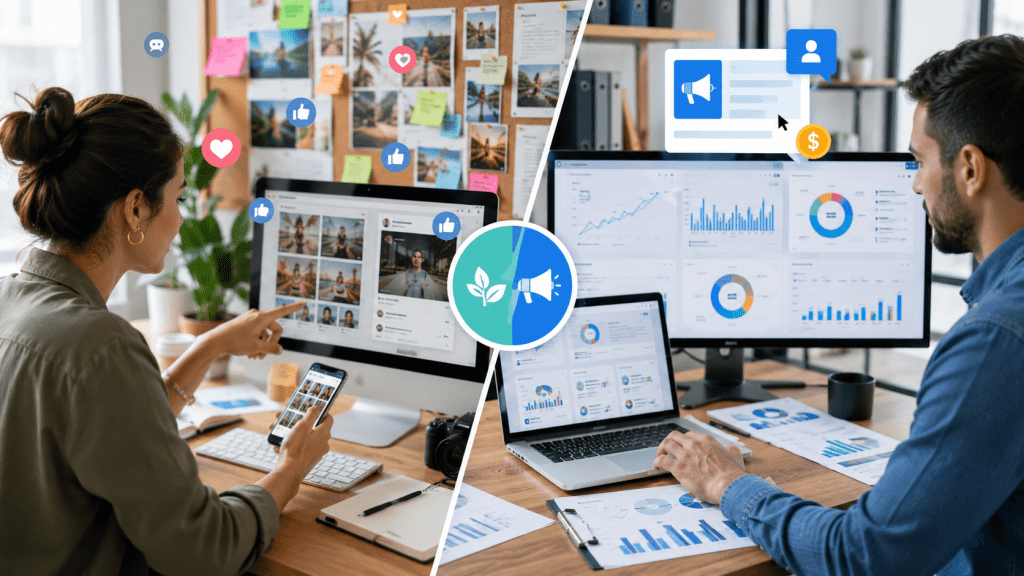
Organic vs Paid Social Media Marketing for Small Businesses
This is one of the most common questions small business owners ask: Should I focus on organic or paid social media?
The honest answer? Both — but in the right sequence.
Organic Social Media
Organic content is anything you post without paying for promotion. It’s your daily posts, Stories, Reels, and engagement. The benefits:
- Builds genuine community and trust over time
- Zero cost beyond time investment
- Creates evergreen content that continues driving results
- Establishes brand authority and personality
The challenge with purely organic is that reach has declined significantly across most platforms. Facebook organic reach for business pages averages under 5%. Instagram’s algorithm is competitive. The days of simply posting and going viral are largely over.
Paid Social Media
Paid advertising — primarily through Meta Ads (Facebook & Instagram) and Google Ads — gives you the ability to reach highly specific audiences at scale, immediately.
Benefits of paid social:
- Immediate visibility and traffic
- Precise audience targeting by demographics, interests, behaviours, and location
- Scalable results — spend more to reach more
- Measurable ROI with detailed analytics
The challenge? It requires budget and strategic knowledge. Poorly managed ads can drain your budget with little return.
The Smart Hybrid Approach
For small businesses, the most effective organic and paid social media strategy is:
- Build organic content consistency first — establish your brand voice and audience
- Identify your best-performing organic content
- Boost that content with paid promotion to amplify what’s already working
- Run dedicated lead generation campaigns alongside organic content
- Use retargeting ads to re-engage website visitors and warm audiences
This approach minimizes wasted ad spend and builds a foundation of trust before asking for conversions.
Running High-ROI Social Media Ads on Meta and Google for Small Brands
Let’s talk about paid advertising in practical terms. Google Ads and Meta Ads management for small businesses can deliver extraordinary ROI — but only when done right.
Meta Ads (Facebook & Instagram)
Meta’s advertising platform remains one of the most powerful tools available to small businesses. Here’s a simple structure to follow:
Campaign Structure for Small Businesses:
1. Awareness Campaigns
- Goal: Reach new audiences who’ve never heard of you
- Format: Video ads, image ads, Reels-style creative
- Targeting: Interest-based, lookalike audiences, broad demographic targeting
- Budget: Start with $5–$15/day
2. Consideration Campaigns
- Goal: Drive traffic to your website, Instagram profile, or landing page
- Format: Carousel ads, video ads with a CTA
- Targeting: Warm audiences who engaged with your previous content
- Budget: $10–$20/day
3. Conversion Campaigns
- Goal: Generate leads, sales, or bookings
- Format: Lead generation forms, website conversion ads
- Targeting: Retargeting (website visitors, video viewers, Instagram engagers)
- Budget: Scale based on cost per result
Key Meta Ads Tips for Small Businesses:
- Always use high-quality creative — bad visuals kill good targeting
- Test 2–3 ad variations per campaign to identify winners
- Never stop a campaign in the first 3–5 days; the algorithm needs time to optimize
- Install the Meta Pixel on your website for tracking and retargeting
Google Ads for Small Businesses
Google Ads work best when people are actively searching for your product or service. Key campaign types:
- Search Ads: Text ads that appear when people search specific keywords. Ideal for service businesses and high-intent purchases.
- Display Ads: Visual banner ads across Google’s network. Great for brand awareness and retargeting.
- YouTube Ads: Video ads on YouTube. Excellent for brand storytelling.
- Performance Max: Google’s AI-powered campaign type that runs across all their channels simultaneously.
For small businesses on a tight budget, start with Google Search Ads targeting high-intent, local keywords. A plumber in London bidding on “emergency plumber London” will see far better ROI than a brand awareness Display campaign.
Social Media Tools and AI Automation for Small Business Marketing
We’re living in a golden era for small business owners. AI automation for social media marketing has democratized capabilities that used to require entire marketing teams. Here are the tools and systems you need to know:
Content Creation Tools
- Canva: Design stunning graphics, carousels, and Reels templates without a designer
- CapCut / Adobe Express: Edit short-form video content quickly and professionally
- ChatGPT / Claude: Generate caption ideas, blog posts, ad copy, and content strategies
- Midjourney / DALL-E: Create unique AI-generated visuals for your content
Scheduling & Management Tools
- Buffer: Simple, affordable scheduling for multiple platforms
- Later: Visual content planner, especially good for Instagram
- Hootsuite: Comprehensive social media management for growing teams
- Meta Business Suite: Free, built-in scheduling and analytics for Facebook & Instagram
AI Automation Tools
- Zapier / Make.com: Automate repetitive tasks — automatically share blog posts to social media, send DM welcome messages, or add leads to your CRM
- ManyChat: Automate Instagram and Facebook DM conversations for lead generation
- Publer: AI-powered scheduling with built-in content suggestions
Analytics & Reporting Tools
- Google Analytics 4: Track social media traffic to your website
- Native Platform Analytics: Instagram Insights, LinkedIn Analytics, Facebook Insights — use these first
- Sprout Social / Metricool: Advanced reporting for agencies and growing businesses
Practical AI Automation Workflows for Small Businesses:
- New blog post → automatically shared to all social platforms via Zapier
- New Instagram follower → automated welcome DM via ManyChat
- Completed lead form → automatic email notification + CRM entry via Make.com
- Weekly performance report → auto-generated and emailed to you every Monday
These automations don’t just save time — they ensure nothing falls through the cracks when you’re busy running your actual business.
Tracking Social Media Analytics and Improving Performance
Strategy without measurement is just guesswork. Tracking your social media KPIs for small business growth is what separates businesses that consistently improve from those that spin their wheels without progress.
Here’s a simple monthly analytics review framework:
Weekly Check (15 minutes):
- Review reach and engagement on recent posts
- Identify the top-performing post of the week
- Check follower growth
- Respond to any unanswered comments or DMs
Monthly Review (1 hour):
- Compare all KPIs against last month
- Identify top 3 performing content pieces — what do they have in common?
- Identify the bottom 3 — what can you improve or stop doing?
- Review ad campaign performance: CPL, CTR, ROAS
- Update your content calendar based on findings
Key Metrics to Track by Goal:
For Brand Awareness: Reach, Impressions, Follower Growth, Share of Voice
For Engagement: Engagement Rate, Comments, Shares, Saves, Story Replies
For Traffic: Click-Through Rate, Link Clicks, Website Sessions from Social
For Leads/Sales: Lead Form Submissions, Conversion Rate, Cost Per Lead, ROAS
The golden rule of social media analytics: don’t just collect data — act on it. Every monthly review should result in at least 2–3 specific changes to your strategy for the following month.
Common Social Media Marketing Mistakes Small Businesses Should Avoid
Experience is the best teacher — but learning from other people’s mistakes is far less painful. Here are the most common pitfalls in social media marketing for small businesses, and how to avoid them:
1. Posting Without a Strategy Just “being active” on social media without clear goals, target audience definition, or content pillars leads nowhere. Always start with strategy.
2. Inconsistency Posting 10 times one week and then disappearing for two weeks destroys momentum and confuses your audience. Consistency beats intensity every time.
3. Over-Promoting If every post is selling something, people will unfollow you. Follow the 80/20 rule — 80% value, 20% promotion.
4. Ignoring Comments and DMs Social media is a two-way conversation. Ignoring your audience is the digital equivalent of hanging up on a customer’s call. Engagement breeds algorithm love and real relationships.
5. Using the Same Content Across All Platforms What works on LinkedIn doesn’t work on TikTok. A 1200-word LinkedIn article doesn’t translate directly to an Instagram caption. Tailor your content to each platform’s format and culture.
6. Not Tracking Results If you’re not measuring, you’re not marketing. Set KPIs, review them monthly, and adjust accordingly.
7. Buying Followers Purchased followers are worthless. They won’t buy from you, engage with your content, or recommend you to anyone. Worse, they’ll actively harm your engagement rate and algorithmic reach. Grow organically and intentionally.
8. Neglecting Video Content In 2026, platforms are aggressively pushing video content. Reels, Shorts, and TikToks generate dramatically more organic reach than static images. If you’re not creating video, you’re leaving enormous opportunity on the table.
9. Having No Clear CTA Every piece of content should have a purpose. What do you want someone to do after reading your post? Visit your website? Send a DM? Save the post? Tell them.
10. Abandoning Platforms Too Quickly Social media growth takes time. Most businesses expect results in 2–4 weeks and give up after 3 months. Real, sustainable social media growth is a 6–12 month game minimum.
Ready-to-Use Social Media Marketing Strategy Template for Small Businesses
Use this template to build your own social media marketing plan for small businesses:
📋 Social Media Marketing Strategy Template
1. Business Overview
- Business Name:
- Industry:
- Target Market (demographics + location):
- Unique Value Proposition:
2. Goals & KPIs (Next 90 Days)
- Primary Goal:
- Secondary Goal:
- KPIs to Track:
3. Target Audience Persona
- Name:
- Age:
- Location:
- Interests:
- Pain Points:
- Platforms They Use:
4. Platform Selection
- Primary Platform:
- Secondary Platform:
- Platforms to Avoid for Now:
5. Content Pillars (Pick 4–5) 1. 2. 3. 4. 5.
6. Content Mix (Weekly)
- Educational posts: 2x/week
- Engagement posts: 2x/week
- Promotional posts: 1x/week
- Behind-the-scenes: 1x/week
- Video/Reels: 2x/week
7. Monthly Content Calendar
- Week 1 Theme:
- Week 2 Theme:
- Week 3 Theme:
- Week 4 Theme:
8. Paid Advertising Plan
- Monthly Ad Budget: $___
- Campaign Type: Awareness / Traffic / Conversions
- Target Audience:
- Creative Format:
9. Tools & Automation
- Scheduling Tool:
- Design Tool:
- Analytics Tool:
- Automation Tool:
10. Monthly Review Schedule
- Review Date Each Month:
- KPIs to Compare:
- Content Changes Based on Data:
Copy this template, fill it in honestly, and revisit it every 30 days. It will transform how you approach social media — from reactive posting to proactive, strategic marketing.
Frequently Asked Questions (FAQ)
1. What is the best social media marketing strategy for small businesses?
The best social media marketing strategy for small businesses combines clear goal-setting, audience research, consistent content creation across 2–3 relevant platforms, a mix of organic and paid promotion, and monthly performance tracking. Focus on providing value to your audience before promoting your services, and use AI tools and scheduling platforms to stay consistent without burning out.
2. How do I create a social media marketing strategy for my small business from scratch?
Start by defining your business goals and target audience. Then choose 2–3 platforms where your audience is most active. Build a content style guide, define 4–5 content pillars, create a monthly content calendar, and set up analytics tracking. Review performance monthly and refine continuously. This guide covers every step in detail.
3. Which social media platforms are best for small businesses globally?
For most small businesses, Instagram and Facebook offer the best combination of reach, advertising power, and audience diversity. B2B businesses should prioritize LinkedIn. Businesses targeting younger audiences should explore TikTok. YouTube is ideal for businesses with strong educational or how-to content. Start with 2 platforms and expand once you’ve mastered them.
4. How much should a small business spend on social media marketing?
There’s no one-size-fits-all answer, but a practical starting point is $200–$500/month for paid ads combined with consistent organic content. As you identify what’s working, scale your budget accordingly. Even $5–$10/day on Meta Ads can produce meaningful results when your targeting and creative are dialled in.
5. How often should small businesses post on social media?
Consistency matters more than frequency. Aim for 3–5 posts per week on Instagram, 1–2 posts daily on Facebook, 3–5 posts per week on LinkedIn, and daily Stories on Instagram. Posting quality content 4 times a week consistently will always outperform posting 14 times one week and disappearing the next.
6. Can small businesses use AI for social media marketing?
Absolutely — and they should. AI automation for social media marketing can help small businesses create content faster, automate scheduling and cross-posting, manage DM responses, and generate performance reports. Tools like ChatGPT, Canva AI, Zapier, Buffer, and ManyChat level the playing field significantly for businesses without large marketing teams.
7. What are the most important social media KPIs for small businesses?
The most important social media KPIs for small business growth depend on your goals, but universally relevant metrics include: engagement rate, reach and impressions, follower growth rate, click-through rate, website traffic from social, leads generated, cost per lead (for paid campaigns), and conversion rate. Review these monthly and act on what the data tells you.
8. How long does it take to see results from social media marketing?
Realistically, 3–6 months of consistent effort is the minimum to see meaningful organic growth. Paid advertising can deliver faster results — sometimes within days — but even ads require testing and optimization before hitting their stride. Social media marketing is a long-term investment. The businesses that commit for 12+ months consistently outperform those looking for overnight results.
9. Should small businesses hire a social media agency or do it themselves?
Early on, many small businesses handle social media in-house to save budget. As the business grows, the time cost of doing it yourself often exceeds the cost of outsourcing. A professional agency like Skyhoora can handle strategy, content creation, ad management, and analytics — allowing you to focus on what you do best: running your business. The right agency pays for itself in results.
10. How do I build a global social media presence as a small business?
To build a global online presence for small business, post content in English, use globally searchable hashtags, optimize your profiles for international discovery, run geo-targeted ads in your target markets, and engage with international communities in your niche. Consistency, quality content, and strategic ad targeting are the biggest levers for international growth.
The Roadmap Is Ready — Now It’s Your Turn
Building a powerful social media marketing strategy for small businesses doesn’t require a massive budget, a corporate marketing team, or years of experience. What it does require is clarity, consistency, and a genuine commitment to showing up for your audience with value — day after day, week after week.
We’ve covered a lot of ground in this guide — from defining your goals and choosing the right platforms, to creating content that converts, running smart paid campaigns, and using AI tools to work more efficiently. The knowledge is here. The template is here. The only thing left is for you to act on it.
Here’s the simplified playbook one final time:
- Set clear, measurable goals tied to real business outcomes
- Know exactly who your audience is and where they spend their time
- Choose 2–3 platforms and commit to consistency
- Build a brand presence that’s recognizable and trustworthy
- Create valuable content across multiple formats using your content pillars
- Plan ahead with a monthly content calendar
- Use hashtags and keywords for discoverability
- Layer in paid advertising to amplify what’s working
- Automate where you can to save time and eliminate inconsistency
- Measure, review, and improve every single month
Social media marketing rewards those who play the long game. Start today, stay consistent, and give it 6 months. You’ll be amazed at what changes.
Need help building a results-driven social media marketing strategy for your business? Skyhoora helps small businesses worldwide with social media management, content marketing, Meta Ads, Google Ads, SEO, analytics tracking, and AI-powered automation solutions.
👉 Visit skyhoora.com and let’s build something that grows.