
If you’re still running your marketing manually in 2026, you’re not just working harder than you need to — you’re falling behind. Businesses that have embraced AI-powered digital marketing are growing faster, spending smarter, and reaching more customers with less effort.
This guide breaks down exactly how AI is reshaping digital marketing — from SEO and content to paid advertising and personalization — and gives you a practical roadmap to implement it, regardless of where you’re located or what size your business is.
What Is AI-Powered Digital Marketing?
AI-powered digital marketing means using artificial intelligence — including machine learning, natural language processing (NLP), and predictive analytics — to automate, optimize, and scale your marketing operations.

In practice, this covers:
- Content creation aligned with search intent and brand voice
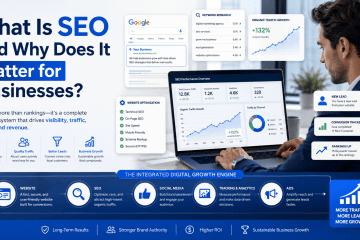
- SEO optimization driven by real-time data and competitor analysis
- Paid ad campaigns that self-optimize bids and creatives automatically
- Email marketing personalized at the individual level
- Social media scheduling timed to peak audience activity
- Chatbots and lead qualification running 24/7 without human input
It isn’t magic — it’s machine learning trained on millions of data points, helping marketers make faster, smarter decisions.
Why AI Has Permanently Changed Digital Marketing
A few years ago, keyword research meant spreadsheets, hours of manual work, and a lot of guesswork. Today, AI tools analyze thousands of data points in seconds and surface exactly what your audience is searching for — before they even finalize the query.
The shift is structural, not seasonal. Brands using AI-powered marketing strategies consistently achieve:
- Faster content production cycles
- Higher organic search rankings
- Better ad performance at lower spend
- Stronger customer retention through personalization
What once required a five-person marketing team can now be handled by one skilled marketer with the right AI stack.
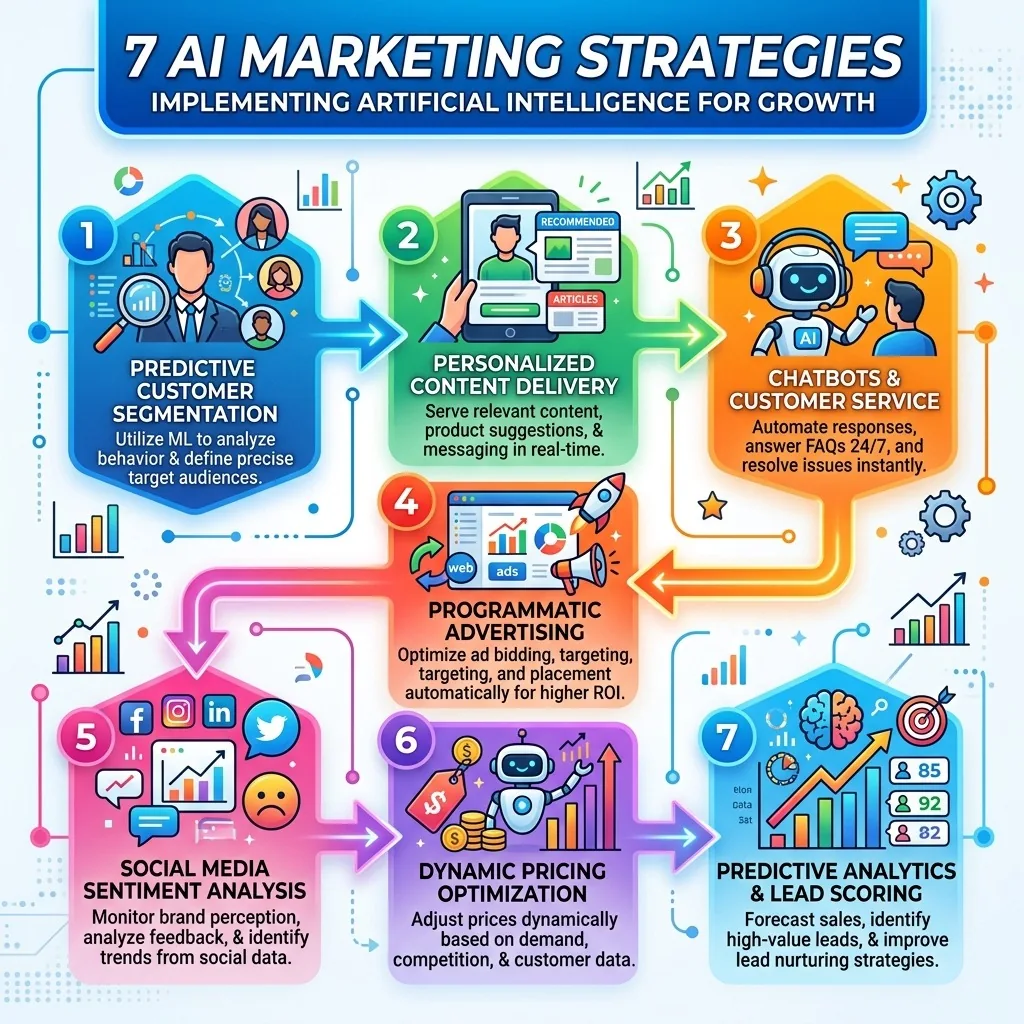
7 AI Marketing Strategies That Drive Real Results in 2026
1. Hyper-Personalization at Scale
The biggest competitive advantage AI gives marketers today is personalization — at scale. AI systems analyze customer behavior (browsing history, purchase patterns, content engagement) and deliver individualized experiences to thousands of users simultaneously.
A mid-size e-commerce brand can now send 50,000 personalized product recommendation emails — each one uniquely tailored — without a single team member doing manual segmentation. That’s the AI personalization advantage.
For businesses competing against larger brands, this levels the playing field entirely.
2. AI-Driven SEO Strategy
Search engine optimization has fundamentally changed. Google’s algorithm now prioritizes content that satisfies user intent over content that simply matches keywords. AI tools are built to understand this shift.
What AI-powered SEO tools help you do:
- Discover low-competition, high-volume keywords your competitors are missing
- Analyze what’s ranking for your target terms and reverse-engineer the content structure
- Identify topical authority gaps across your website
- Generate optimized meta titles, descriptions, and schema markup automatically
- Monitor competitor movements and ranking changes in real time
In 2026, the brands ranking on page one are the ones using AI to understand intent — not just keyword frequency.
3. AI Content Creation That Actually Ranks
Let’s be precise: AI content isn’t about publishing generic, low-effort blog posts. The best AI content workflows combine AI generation with human expertise, judgment, and brand voice.
The practical process:
- Use AI tools to research trending topics and identify search intent
- Generate a structured draft with relevant headings, keywords, and content depth
- Layer in real-world experience, original insights, and brand personality
- Optimize with AI SEO tools before publishing
This approach produces content that ranks well on search engines and reads as genuinely authoritative — because it combines the efficiency of AI with the credibility only human expertise provides.
For WordPress site owners, AI plugins can automate meta tag generation, heading optimization, and internal linking suggestions, saving hours of post-publishing work.
4. Predictive Analytics: Marketing Before the Trend Hits
Predictive analytics is one of the most powerful — and underused — AI marketing capabilities available today.
Instead of reacting to trends, AI analyzes historical data, seasonality patterns, and real-time signals to tell you what’s coming. For e-commerce businesses, this means knowing which products to push in your next campaign before the demand spike. For content marketers, it means publishing on a trending topic two weeks before it peaks.
This kind of forward-looking intelligence used to be exclusive to enterprise brands with data science teams. In 2026, it’s accessible to any business using the right tools.
5. AI-Optimized Paid Advertising
Running paid ads without AI optimization in 2026 is the equivalent of bidding blind. AI advertising platforms — built into Google Ads, Meta Ads, and third-party tools — constantly test combinations of headlines, visuals, audiences, and bid strategies to find what converts.
Key capabilities of AI ad optimization:
- Real-time bid adjustments based on conversion probability
- Automatic creative testing across hundreds of ad variations
- Smart audience expansion to reach similar high-converting users
- Budget reallocation from underperforming campaigns to winning ones — automatically, 24/7
The result is lower cost-per-acquisition and higher return on ad spend, without the manual work of A/B testing every variable yourself.
6. AI Chatbots for Lead Qualification
Modern AI chatbots are far beyond the basic rule-based popups of earlier years. In 2026, conversational AI understands context, asks qualifying follow-up questions, routes leads by intent, books appointments automatically, and hands off only the most sales-ready prospects to your team.
The impact is measurable: businesses deploying AI chatbots on their websites consistently report 30–50% improvements in lead qualification rates, while their sales teams focus exclusively on high-intent prospects.
For any business operating globally, AI chatbots also solve the time zone problem — your leads get instant, intelligent responses at 2 AM, regardless of where they’re located.
7. AI-Powered Social Media and Video Marketing
Video is the dominant content format of 2026. AI tools now convert long-form blog posts and articles into short-form videos — complete with captions, voiceovers, and b-roll visuals — formatted for YouTube Shorts, Instagram Reels, and TikTok.
On the social media management side, AI analyzes your audience behavior to identify peak engagement windows, auto-schedules content for maximum reach, generates captions and hashtag sets, and provides predictive performance scoring before you publish.
This multiplies your content output without proportionally increasing your workload.
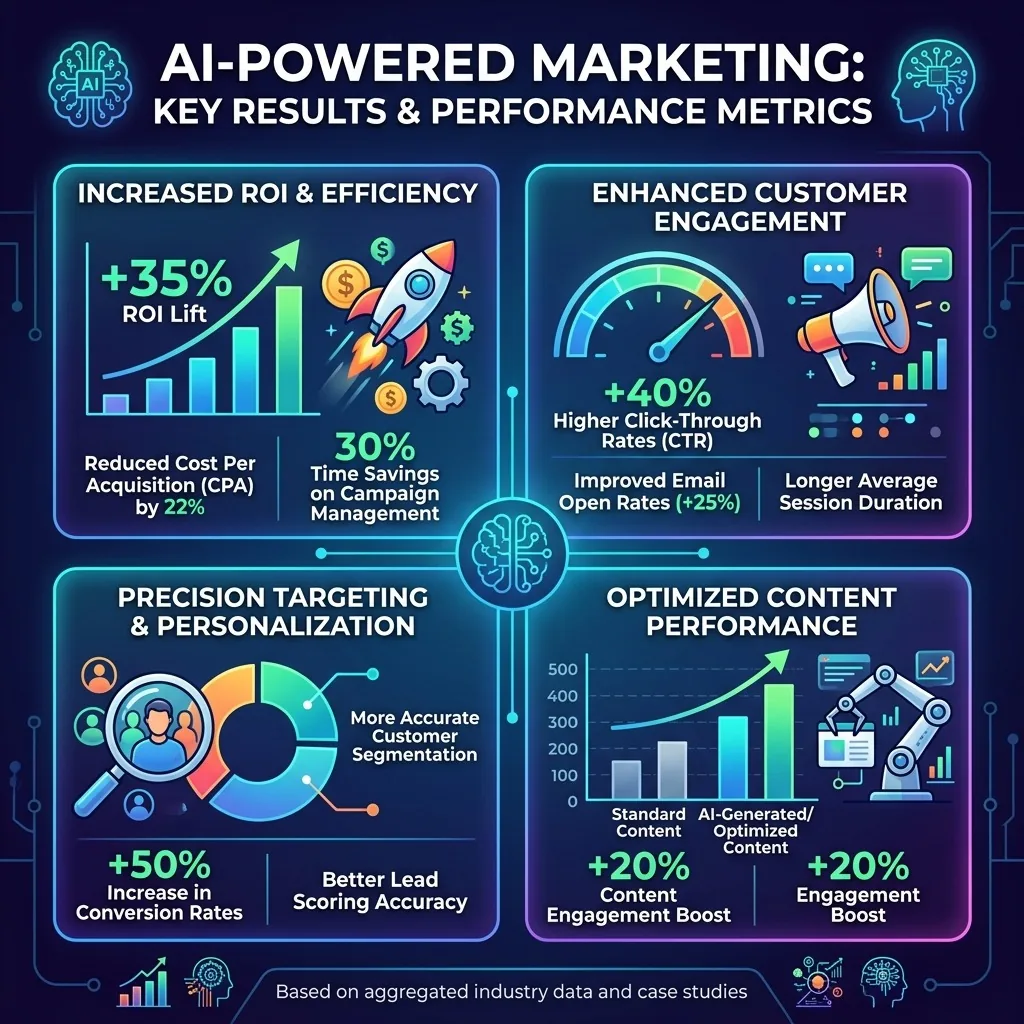
Proven Results: What AI Marketing Delivers
Businesses that have fully integrated AI into their marketing operations report consistent improvements across key metrics:
| Metric | Typical Improvement |
|---|---|
| Organic traffic growth | 150–200% within 6 months |
| Content production time | 50–65% reduction |
| Ad spend ROI | 80–100% improvement |
| Email open rates | 15–20 percentage point increase |
| Lead conversion rate | 40–100% improvement |
These are outcomes driven by the combination of human strategy and AI execution — not AI alone.
Top AI Marketing Tools in 2026
| Category | Tool | Best For |
|---|---|---|
| Content Creation | ChatGPT, Claude | Drafting, ideation, editing |
| Copywriting | Jasper | Brand-aligned ad and web copy |
| SEO Research | SEMrush, Ahrefs | Keyword research, competitor analysis |
| Website Analytics | Google Analytics 4 | AI-driven behavioral insights |
| Design | Canva AI | Social media graphics, visual content |
| Email Marketing | Mailchimp AI | Segmentation, send-time optimization |
| Social Scheduling | Hootsuite AI | Multi-platform automation and analytics |
| Project Management | Notion AI | Content calendars, campaign planning |
| WordPress SEO | Rank Math, AIOSEO | On-page SEO automation |
| Ad Platforms | Google Performance Max, Meta Advantage+ | AI-driven paid campaigns |
7 Common AI Marketing Mistakes to Avoid
- Publishing without human review — AI generates drafts; your expertise shapes the final output. Always add original insights before publishing.
- Ignoring data privacy regulations — GDPR, CCPA, and regional data protection laws apply regardless of which AI tools you use. Review compliance before deploying personalization features.
- Over-automating customer interactions — Complex service issues, refunds, and complaints still require human judgment. Use AI for qualification and routing, not resolution.
- Chasing new tools without mastering existing ones — Depth beats breadth. One AI tool used well outperforms five used poorly.
- Skipping performance tracking — AI tools generate activity, not automatically results. Track ROI, organic traffic, conversion rates, and engagement against clear benchmarks.
- Forgetting E-E-A-T — Google’s ranking systems reward Experience, Expertise, Authoritativeness, and Trustworthiness. AI content needs human expertise layered in to meet this standard.
- Treating AI as a replacement — AI amplifies human marketers; it doesn’t replace strategic thinking, relationship-building, or creative direction.
How to Start AI Marketing: A 7-Step Action Plan
- Audit your current workflow — Identify the most time-consuming, repetitive marketing tasks such as keyword research, meta tags, social scheduling, and email segmentation.
- Choose one starting point — Pick a single AI tool relevant to your biggest bottleneck. Content, SEO, or ads are strong entry points.
- Learn the tool properly — Spend a week on tutorials and documentation before going live. Most AI tools have free tiers to practice with.
- Run a small test campaign — Apply AI to one campaign or content project before scaling. Track results against your previous baseline.
- Measure with real metrics — Use Google Analytics 4, your ad platform dashboards, and keyword tracking tools to quantify improvement.
- Scale what works — Once you’ve validated ROI on one AI application, expand to the next workflow.
- Stay current — AI marketing tools and capabilities evolve rapidly. Follow industry publications like Search Engine Journal and Marketing AI Institute to stay ahead.
The Bottom Line
AI-powered digital marketing is no longer a competitive advantage — it’s the baseline requirement for staying relevant in 2026. Businesses that combine human strategy with AI execution are growing faster, spending smarter, and building more sustainable operations.
You don’t need to be a developer or data scientist to get started. The tools available today are built for marketers. Start with one workflow, prove the ROI, then scale systematically.
The businesses winning in 2026 aren’t the ones with the biggest budgets — they’re the ones that adopted AI the fastest.
Frequently Asked Questions
Q1: What is AI-powered digital marketing? AI-powered digital marketing uses artificial intelligence — including machine learning, NLP, and predictive analytics — to automate and optimize marketing tasks such as content creation, SEO, paid advertising, email campaigns, and customer personalization. It enables brands to grow faster through data-driven decision-making.
Q2: How does AI improve digital marketing results in 2026? AI enables hyper-personalization, predictive trend analysis, real-time ad optimization, automated content production, and intent-based SEO strategies. These capabilities directly improve organic traffic, conversion rates, ad ROI, and customer engagement — for businesses of all sizes.
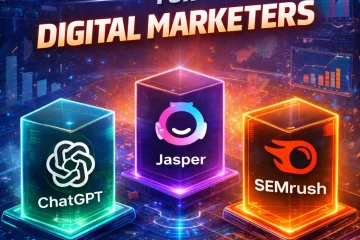
Q3: What are the best AI tools for digital marketing in 2026? The most effective AI marketing tools include ChatGPT and Claude for content creation, Jasper for brand copywriting, SEMrush and Ahrefs for SEO research, Google Analytics 4 for behavioral insights, Canva AI for design, Mailchimp AI for email automation, and Meta Advantage+ and Google Performance Max for AI-driven advertising.
Q4: Is AI replacing digital marketers? No. AI handles research, data analysis, routine content drafting, and repetitive optimization tasks. Human marketers focus on strategy, brand voice, creative direction, and relationship-building — work AI cannot replicate. The result is a more productive marketer, not a redundant one.
Q5: How much does AI marketing cost for small businesses? Many leading AI marketing tools offer free tiers. Paid plans typically start between $10–$50 per month. You can begin with free versions of ChatGPT, Google Analytics 4, and WordPress AI plugins, then invest in premium tools as you demonstrate measurable ROI.
Q6: Can AI improve my website’s SEO ranking? Yes. AI SEO tools analyze search intent, identify low-competition keyword opportunities, optimize on-page content structure, generate meta tags and schema markup, and monitor competitor rankings. Used consistently, they significantly improve your chances of ranking on page one.
Q7: What are the risks of using AI in digital marketing? Key risks include publishing AI content without human review, data privacy violations from improper use of customer data, over-reliance on automation in customer-facing roles, and reduced content originality if AI drafts are published unedited. All are manageable with proper workflows and oversight.
Q8: How does AI help with social media marketing? AI analyzes audience behavior to identify optimal posting times, auto-schedules content, generates captions and hashtags, creates short-form video content from text, and provides predictive engagement scoring — reducing manual workload while improving content performance.
Q9: Will AI marketing work for my WordPress website? Yes. WordPress integrates with AI plugins like Rank Math and AIOSEO for automated on-page SEO, and with AI writing tools for content creation. These integrations streamline meta optimization, internal linking, and content suggestions directly within the WordPress dashboard.
Q10: How quickly can I see results from AI-powered marketing? SEO improvements typically begin showing within 3–6 months of consistent AI-assisted content and optimization. Paid advertising improvements can be visible within days of enabling AI bidding and creative testing. Email and social media results often improve within the first 30 days of automation.
Frequently Asked Questions
What is AI-powered digital marketing?
AI-powered digital marketing uses machine learning, natural language processing, and predictive analytics to improve research, content, advertising, personalization, and measurement.
Can small businesses use AI for digital marketing?
Yes. Small businesses can use focused AI tools to accelerate research, improve content workflows, personalize communication, and analyze campaign performance without building a large team.
Does AI replace human marketing strategy?
No. AI can accelerate tasks and surface insights, but human judgment remains essential for positioning, accuracy, creativity, ethics, and customer understanding.