

Many businesses have a website, social media pages, and even good products or services. But still, they struggle with one big problem: people cannot find them online.
A business owner may spend money on a beautiful website, write a few service pages, post on Instagram, and wait for customers. But if the website does not appear when people search on Google, that website becomes like a shop hidden in a street where no one walks.
This is where SEO becomes important.
SEO helps your business become visible when people are already searching for your products, services, or solutions. It helps your website appear in search engines like Google so the right people can discover your business at the right time.
For example, if someone searches “best digital marketing agency for small business,” “website design service near me,” or “how to grow my business online,” SEO helps your website show up for those types of searches.
SEO is not just about ranking higher on Google. It is about building online visibility, trust, traffic, leads, and long-term business growth. For small businesses, startups, local service providers, and online brands, SEO can become one of the most valuable digital growth systems.
In this guide, you will learn what SEO is, how it works, why SEO matters for businesses, and how it can help your business grow online.
What Is SEO in Simple Words?
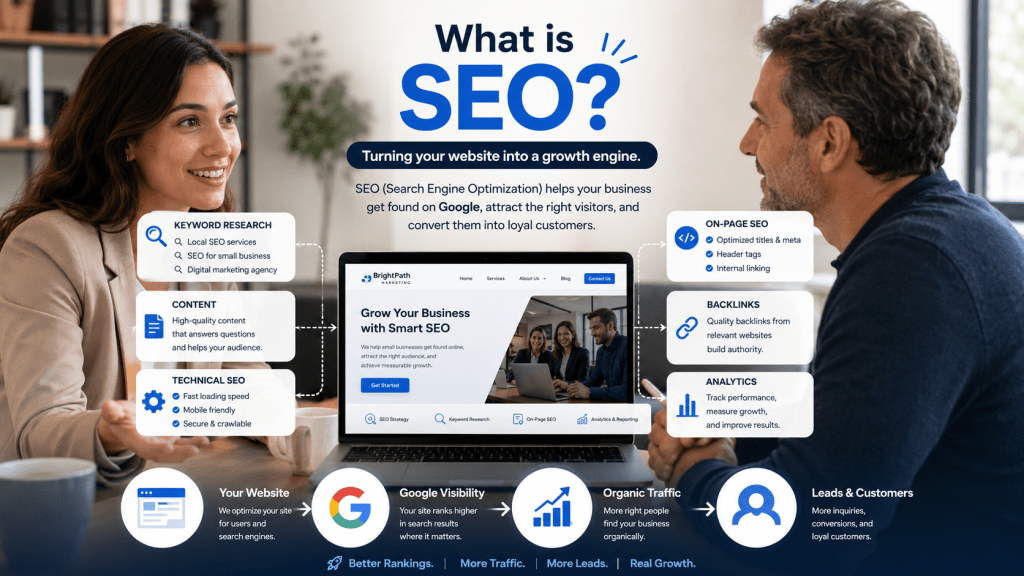
SEO stands for Search Engine Optimization.
In simple words, SEO is the process of improving your website so search engines like Google can understand it, trust it, and show it to people who are searching for relevant information, products, or services.
A simple definition of SEO is:
SEO is the process of optimizing your website to rank higher on search engines and attract more organic traffic from people who are actively searching for what your business offers.
Organic traffic means visitors who come to your website from unpaid search results. You do not pay for every click like you do with ads. Instead, your website earns visibility because it is useful, relevant, and properly optimized.
For example, imagine you own a dental clinic. If someone searches “best dentist near me” or “teeth cleaning clinic in my city,” you would want your website or Google Business Profile to appear in the search results. SEO helps make that possible.
SEO includes many things, such as:
- Writing helpful website content
- Using the right keywords
- Improving website speed
- Making the website mobile-friendly
- Optimizing titles and descriptions
- Creating useful blog posts
- Building trust through backlinks
- Improving local visibility
- Making the website easy for Google to crawl and understand
SEO is not a one-time task. It is an ongoing process that improves your website’s online presence over time.
What Does SEO Stand For?
SEO stands for Search Engine Optimization.
Let’s break it down in a simple way.
Search Engine
A search engine is a platform that helps people find information online. Google is the most popular search engine, but there are others too, such as Bing, Yahoo, DuckDuckGo, and AI-powered search platforms.
When someone types a question or keyword into Google, the search engine tries to show the most relevant and helpful results.
For businesses, this matters because customers use search engines every day to find:
- Local services
- Product reviews
- Business solutions
- Price comparisons
- Nearby stores
- Professional agencies
- Answers to problems
- Trusted service providers
If your business does not appear in search results, your competitors may get those visitors instead.
Optimization
Optimization means improving something so it performs better.
In SEO, optimization means improving your website so search engines and users both understand it better. This includes improving your content, website structure, page speed, technical setup, user experience, and authority.
Business Relevance
For a business, SEO connects your website with people who are already searching for your services.
Instead of interrupting people with random ads, SEO helps your business appear when people already have interest or intent. That is why SEO in digital marketing is so powerful. It brings your business closer to people who are actively looking for a solution.
How Does SEO Work?
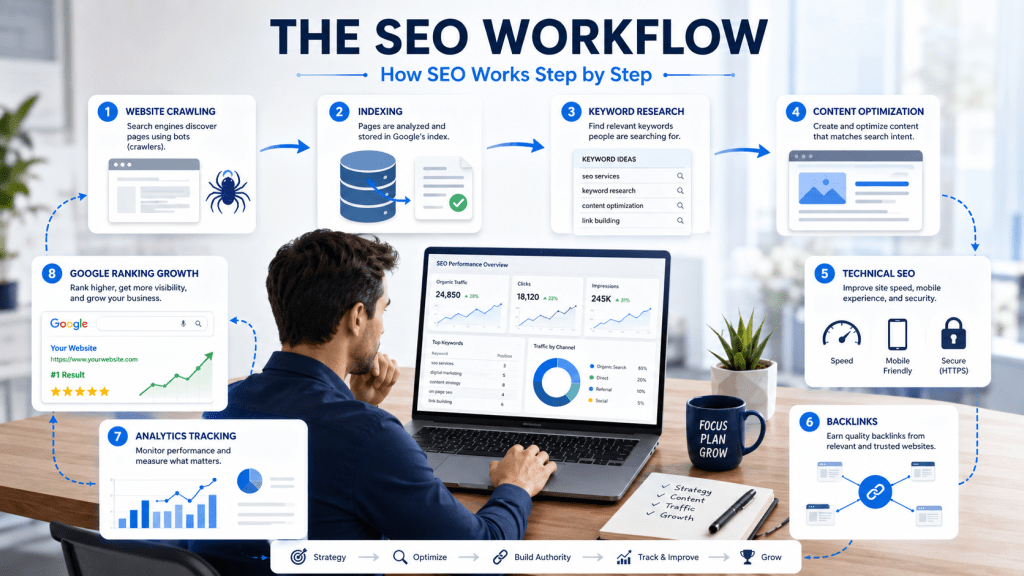
SEO works by helping search engines discover, understand, evaluate, and rank your website.
Search engines use automated systems to explore web pages, understand content, and decide which pages should appear for different searches. While the process is complex, the basic idea is simple.
1. Crawling
Crawling is the process where search engines visit web pages using automated bots, often called crawlers or spiders.
These crawlers move from one page to another through links. If your website has a good structure and proper internal linking, search engines can discover your pages more easily.
For example, if your homepage links to your services page, blog posts, and contact page, crawlers can understand how your website is organized.
2. Indexing
After crawling, search engines try to understand the content of your page. This process is called indexing.
If a page is indexed, it means the search engine has stored information about that page in its database. When users search for related topics, your indexed page may be considered for ranking.
If your page is not indexed, it usually cannot appear in search results.
3. Ranking
Ranking is the process of deciding which pages should appear first for a search query.
Search engines consider many factors, including:
- Relevance of content
- Keyword usage
- Search intent
- Website quality
- Page speed
- Mobile experience
- Backlinks
- Internal linking
- User experience
- Trust and authority
- Technical SEO health
The goal of SEO is to improve these areas so your website has a better chance of ranking for relevant searches.
4. Keywords
Keywords are the words and phrases people type into search engines.
For example:
- “what is SEO”
- “SEO for small business”
- “best website design agency”
- “how to increase website traffic”
- “local SEO services near me”
Keyword research helps you understand what your audience is searching for. Then, you can create content around those topics.
But SEO is not about repeating keywords again and again. That is called keyword stuffing, and it can harm readability. Good SEO uses keywords naturally inside helpful content.
5. Search Intent
Search intent means the reason behind a search.
For example, someone searching “what is SEO” wants information. Someone searching “SEO agency for small business” may be looking for a service provider. Someone searching “hire SEO expert” may be ready to take action.
SEO works best when your content matches the user’s intent.
There are mainly four types of search intent:
- Informational intent: The user wants to learn something.
- Commercial intent: The user is comparing options.
- Transactional intent: The user is ready to buy or contact.
- Local intent: The user wants a nearby business or service.
A strong SEO strategy creates content for all these stages.
6. Content Quality
Search engines want to show helpful, clear, and relevant content. That means your website should answer real questions and solve real problems.
Good SEO content is:
- Easy to understand
- Helpful for the target audience
- Well-structured
- Original
- Relevant to the topic
- Written for humans first
- Optimized for search engines second
For business websites, content should not only explain services. It should also educate, build trust, answer objections, and guide visitors toward action.
7. User Experience
SEO is not only about keywords. A website must also be easy to use.
If your website loads slowly, looks confusing, or does not work properly on mobile, visitors may leave quickly. This can affect your overall performance.
A good SEO-friendly website should be:
- Fast
- Mobile-friendly
- Easy to navigate
- Clear in design
- Secure
- Simple to read
- Focused on user needs
8. Backlinks and Authority
Backlinks are links from other websites to your website.
When trusted websites link to your content, it can help build your website’s authority. Think of backlinks like recommendations. If good websites refer to your website, search engines may see your site as more trustworthy.
But quality matters more than quantity. A few good backlinks from relevant websites are better than many low-quality spam links.
Why Does SEO Matter for Businesses?
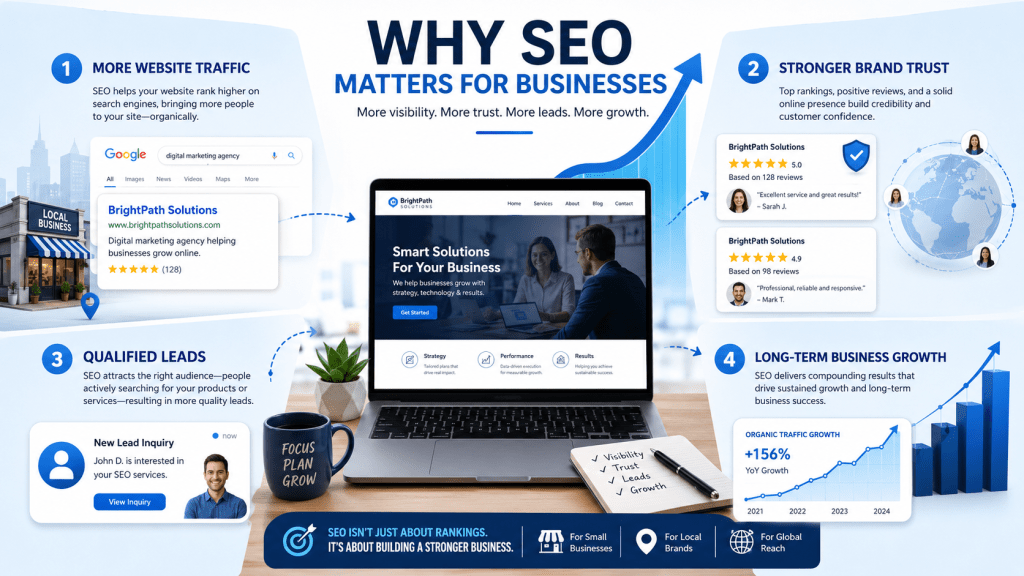
SEO matters because your customers are already searching online.
Whether you run a local business, startup, service-based company, e-commerce brand, or professional agency, your audience uses search engines to find answers and solutions.
If your business is not visible, you may lose traffic, leads, and customers to competitors who are better optimized.
SEO Builds Visibility
A website without SEO may exist online, but it may not be discoverable.
SEO helps your website appear for relevant search queries. The more visible your business becomes, the more opportunities you have to attract potential customers.
For example, a local restaurant can appear for “best restaurant near me.” A real estate consultant can appear for “property consultant in Delhi.” A digital growth agency can appear for “SEO services for small business.”
Visibility is the first step toward traffic and leads.
SEO Builds Trust
People often trust businesses that appear in search results, especially when the website looks professional and provides helpful information.
If your website answers questions clearly, loads well, and appears consistently for relevant topics, it can build credibility in the mind of your audience.
SEO helps your business look more established, reliable, and active online.
SEO Brings Organic Traffic
Organic traffic is one of the biggest benefits of SEO for business.
When your pages rank for useful keywords, people can visit your website without you paying for every click. This makes SEO valuable for long-term marketing.
Paid ads stop when your budget stops. SEO can keep bringing traffic over time if your content and website remain useful and optimized.
SEO Supports Lead Generation
SEO brings people who are already interested in your topic, product, or service.
For example, someone searching “website design agency for small business” is not just randomly browsing. That person may be actively looking for a solution.
When SEO is combined with strong landing pages, clear calls to action, contact forms, tracking, and lead generation systems, it can become a powerful growth channel.
SEO Helps Long-Term Business Growth
SEO takes time, but it builds long-term value.
Every optimized service page, blog post, local page, and helpful guide can become a long-term asset for your business. These pages can continue attracting visitors, building trust, and generating leads over time.
That is why SEO should be seen as a long-term growth system, not just a quick marketing tactic.
Top Benefits of SEO for Businesses
SEO gives businesses many practical benefits. Here are the most important ones.
1. More Organic Traffic
SEO helps your website attract visitors from search engines without paying for every click.
When your website ranks for relevant keywords, people can discover your business while searching for solutions.
For example, a small business that ranks for “social media marketing for local businesses” can attract visitors who are already interested in that service.
2. Better Google Visibility
Most people do not search beyond the first few results. If your website is not visible, your competitors may get the attention.
SEO improves your chances of appearing in search results for keywords related to your business.
Better visibility means more people can find your website, learn about your services, and contact your business.
3. More Qualified Leads
SEO can bring high-intent visitors.
These are people who are already searching for something related to your business. They may need information, comparison, pricing, or a service provider.
When your content matches their intent, SEO can help convert those visitors into leads.
4. Improved Brand Trust
When your website appears for multiple helpful searches, people start recognizing your brand.
A business that consistently provides useful content can build authority in its niche. Over time, this trust can help people choose your business over competitors.
5. Long-Term Marketing Value
SEO is not instant, but it can create lasting value.
A well-optimized blog post or service page can bring traffic for months or even years if it stays relevant and updated.
This makes SEO different from paid ads, where traffic stops when the campaign stops.
6. Better User Experience
SEO encourages businesses to improve website speed, mobile responsiveness, navigation, content structure, and page quality.
These improvements do not only help search engines. They also help real users.
A better website experience can increase engagement, inquiries, and conversions.
7. Higher Conversion Chances
SEO brings people who are already searching for a solution. That means they may be more likely to take action compared to cold audiences.
If your website has strong content, clear service pages, testimonials, case studies, contact forms, and CTAs, SEO traffic can convert into real business opportunities.
8. Competitive Advantage
If your competitors are investing in SEO and you are not, they may appear before you in search results.
But if you build a strong SEO strategy, you can compete even with bigger brands by targeting specific keywords, local searches, niche topics, and helpful content.
9. Lower Dependency on Paid Ads
Paid ads are useful, but relying only on ads can be risky. If ad costs increase or your budget stops, your traffic can drop quickly.
SEO helps reduce dependency on paid ads by building organic visibility.
The best digital growth strategy often combines SEO for long-term growth and paid ads for faster visibility.
Types of SEO Every Business Should Know
SEO has different parts. A complete SEO strategy usually includes on-page SEO, off-page SEO, technical SEO, local SEO, and content SEO.
On-Page SEO
On-page SEO means optimizing the content and elements on your website pages.
This includes:
- Page titles
- Meta descriptions
- Headings
- Keywords
- Internal links
- Image alt text
- URL structure
- Content quality
- Call-to-action placement
For example, if you have a service page for “SEO services for small business,” your page should clearly explain the service, who it is for, benefits, process, FAQs, and why someone should contact you.
On-page SEO helps both users and search engines understand your page.
Off-Page SEO
Off-page SEO includes activities outside your website that help build authority and trust.
The most common part of off-page SEO is backlink building.
Other off-page SEO activities may include:
- Brand mentions
- Guest posting
- Digital PR
- Business listings
- Social signals
- Online reputation building
- Partnerships and collaborations
Off-page SEO shows search engines that your website is trusted by others.
Technical SEO
Technical SEO focuses on the backend and technical health of your website.
It includes:
- Website speed
- Mobile friendliness
- Secure HTTPS setup
- XML sitemap
- Robots.txt
- Crawlability
- Indexing
- Structured data/schema
- Core Web Vitals
- Fixing broken links
- Canonical tags
Technical SEO is important because even good content may struggle if your website has technical problems.
For example, if Google cannot crawl your important pages, those pages may not appear in search results.
Local SEO
Local SEO helps businesses appear in location-based searches.
This is very important for businesses that serve customers in specific cities, areas, or regions.
Local SEO includes:
- Google Business Profile optimization
- Local keywords
- Customer reviews
- Local citations
- Location pages
- Map visibility
- Accurate business name, address, and phone number
- Local service content
For example, a salon, clinic, restaurant, gym, real estate agent, or local service provider can use local SEO to attract nearby customers.
Content SEO
Content SEO focuses on creating useful content that answers search queries.
This includes:
- Blog posts
- Guides
- Service page content
- FAQs
- Case studies
- Comparison pages
- How-to articles
- Industry insights
Content SEO helps your business rank for informational, commercial, and transactional searches.
For example, a digital marketing agency can publish blogs like:
- What is SEO?
- SEO vs paid ads
- How to improve website traffic
- Local SEO checklist for small businesses
- Social media marketing strategy for small businesses
This type of content builds trust and brings relevant visitors to your website.
Why SEO Is Important for Small Businesses
SEO for small business is especially important because small businesses often have limited marketing budgets.
A big brand may spend heavily on ads, sponsorships, and large campaigns. But a small business can still compete by targeting the right keywords, local searches, and helpful content.
Small Businesses Can Target Local Customers
Local SEO helps small businesses appear when nearby customers search for services.
For example:
- “bakery near me”
- “best gym in Delhi”
- “digital marketing agency for small business”
- “website designer near me”
- “plumber in my area”
These searches often come from people who are ready to take action.
SEO Builds Trust Without a Huge Budget
A small business may not have a large advertising budget, but it can still build trust through helpful content, optimized pages, customer reviews, and a professional website.
When people find your business on Google and see clear information, they are more likely to trust you.
SEO Helps Small Businesses Compete With Bigger Brands
Small businesses do not always need to target broad and highly competitive keywords.
They can target:
- Local keywords
- Long-tail keywords
- Service-specific keywords
- Problem-based searches
- Niche audience searches
For example, instead of targeting “SEO,” a small agency can target “SEO services for small business owners” or “local SEO strategy for service businesses.”
These keywords may be easier to rank for and more relevant to the audience.
SEO vs Paid Ads: Which Is Better for Business Growth?
SEO and paid ads both have value, but they work differently.
SEO
SEO focuses on organic growth. It takes time, but it can create long-term visibility.
Benefits of SEO:
- Long-term traffic
- Builds trust
- Reduces dependency on ads
- Supports brand authority
- Helps with organic lead generation
Limitations of SEO:
- Takes time
- Requires consistent effort
- Results depend on competition and website quality
- Needs regular updates and tracking
Paid Ads
Paid ads, such as Google Ads and Facebook Ads, can bring faster visibility.
Benefits of paid ads:
- Faster traffic
- Quick campaign testing
- Audience targeting
- Useful for offers and launches
- Can generate leads quickly when done properly
Limitations of paid ads:
- Traffic stops when budget stops
- Costs can increase
- Requires proper tracking and optimization
- Poor landing pages can waste ad spend
Which One Should a Business Choose?
The best strategy is often not SEO or paid ads. It is SEO and paid ads together.
SEO builds long-term organic growth. Paid ads bring faster visibility and data. When both work together with proper analytics tracking, landing pages, and retargeting, businesses can create a stronger growth system.
For example, a business can use SEO to rank for long-term keywords and use paid ads to promote offers, retarget website visitors, and generate faster leads.
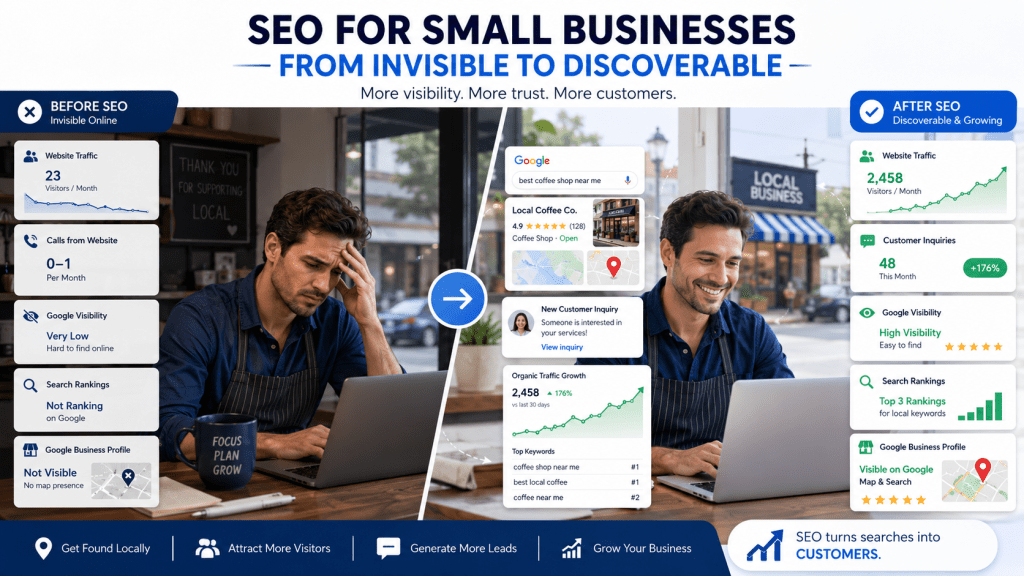
How SEO Helps Businesses Generate Leads
SEO helps businesses generate leads by attracting people who are already searching for relevant solutions.
This is different from showing ads to people who may not be interested. With SEO, the user has already taken the first step by searching.
Informational Searches
These are searches where people want to learn.
Examples:
- “what is SEO”
- “how does SEO work”
- “why is SEO important”
- “how to improve website traffic”
A business can attract these users through helpful blog content. These users may not buy immediately, but they can become aware of your brand.
Commercial Searches
These are searches where people compare options.
Examples:
- “best SEO agency for small business”
- “SEO services for business”
- “SEO vs Google Ads”
- “best digital marketing agency”
These users are closer to making a decision. Strong service pages, comparison content, and case studies can help convert them.
Transactional Searches
These are searches where people are ready to take action.
Examples:
- “hire SEO expert”
- “book SEO consultation”
- “website SEO audit service”
- “local SEO agency near me”
These keywords can generate direct leads if your page has a clear offer, strong CTA, and easy contact option.
Local Searches
Local searches are powerful for service-based businesses.
Examples:
- “SEO agency near me”
- “website designer in Delhi”
- “best salon near me”
- “tax consultant near me”
Local SEO helps your business appear in Google Maps and local search results.
Common SEO Mistakes Businesses Should Avoid
Many businesses do SEO, but they do it without a clear strategy. Here are common mistakes to avoid.
1. Ignoring Keyword Research
Creating content without keyword research is like building a shop without knowing what customers are looking for.
Keyword research helps you understand your audience’s search behavior.
2. Writing Thin Content
Thin content does not provide enough value. It may be too short, generic, or copied from other websites.
Good SEO content should answer the user’s question clearly and completely.
3. Not Optimizing Service Pages
Many businesses only focus on blogs and ignore service pages.
Your service pages should be optimized with clear headings, benefits, process, FAQs, internal links, and CTAs.
4. Poor Website Speed
A slow website can frustrate users and reduce conversions.
Website speed is important for both user experience and SEO performance.
5. No Mobile Optimization
Many users browse websites on mobile. If your website does not work properly on mobile, you may lose potential customers.
A mobile-friendly website is essential for SEO and conversions.
6. No Internal Linking
Internal links help users and search engines move through your website.
For example, a blog about SEO should link to your SEO services page, website optimization page, and contact page.
7. Ignoring Local SEO
Local businesses often miss Google Business Profile optimization, local keywords, and customer reviews.
This can reduce visibility in local searches.
8. Not Tracking Analytics
Without tracking, you cannot know what is working.
Businesses should use tools like Google Analytics, Google Search Console, Google Tag Manager, and conversion tracking to measure traffic, user behavior, leads, and campaign performance.
9. Expecting Overnight Results
SEO takes time. Businesses that expect instant rankings often stop too early.
A strong SEO strategy needs consistency, patience, and improvement.
10. Using AI Content Without Human Editing
AI tools can help with content ideas and drafts, but publishing raw AI content without human review can make your content generic.
Human editing is important for accuracy, originality, brand voice, examples, and trust.
How Long Does SEO Take to Show Results?
SEO usually takes time because search engines need to crawl, index, evaluate, and rank your website.
There is no fixed timeline for every business. SEO results depend on many factors, such as:
- Website age
- Competition level
- Keyword difficulty
- Content quality
- Technical SEO health
- Backlink profile
- Local SEO setup
- Website speed
- Publishing consistency
- Industry and location
For a new website, SEO may take several months to show meaningful results. For an existing website with good authority and technical health, improvements may appear sooner.
A realistic SEO approach is to focus on consistent progress instead of instant results.
SEO should be measured through:
- Organic traffic growth
- Keyword ranking improvements
- Search impressions
- Click-through rate
- Leads and inquiries
- Local visibility
- Conversion rate
- Indexed pages
- User engagement
SEO is not about quick tricks. It is about building a strong online foundation that grows over time.
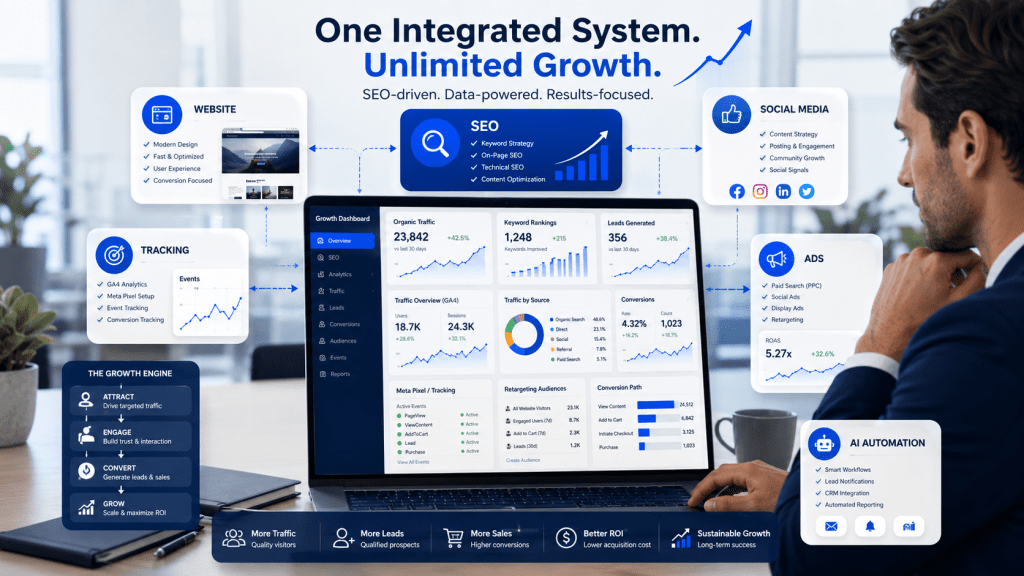
How Skyhoora Helps Businesses With SEO
At Skyhoora, SEO is not treated as a single service in isolation. SEO works best when it is part of a complete digital growth system.
Many businesses struggle because their website, content, tracking, ads, and lead generation are not connected. They may have a website but no traffic. They may have traffic but no leads. They may run ads but have no proper tracking. They may post content but have no strategy.
Skyhoora helps businesses build a more complete online growth system through SEO and connected digital marketing services.
Website Optimization
A strong SEO strategy starts with a strong website.
Skyhoora helps improve website structure, speed, mobile experience, landing pages, content layout, CTAs, and user journey so visitors can understand your business clearly.
SEO Strategy
Skyhoora creates SEO strategies based on business goals, audience, keywords, competition, and growth opportunities.
This includes:
- Keyword research
- Competitor analysis
- Service page optimization
- Blog content planning
- Local SEO planning
- Technical SEO recommendations
- Internal linking structure
Content Planning
Content is one of the most important parts of SEO.
Skyhoora helps businesses plan helpful content that answers real customer questions, supports search intent, and builds trust.
This may include blog posts, service pages, FAQs, landing page content, and educational guides.
Technical SEO
Technical SEO helps search engines crawl, index, and understand your website properly.
Skyhoora can help identify and improve technical issues such as site speed, indexing problems, sitemap setup, broken links, page structure, mobile experience, and schema opportunities.
Local SEO
For local businesses, Skyhoora helps improve local visibility through Google Business Profile optimization, local keywords, location-based content, review strategy, and local search improvements.
Analytics and Tracking
SEO without tracking is incomplete.
Skyhoora helps businesses set up tracking systems such as:
- Google Analytics 4
- Google Tag Manager
- Google Search Console
- Meta Pixel
- Conversion tracking
- Lead tracking
- Retargeting setup
This helps businesses understand where traffic comes from, what users do on the website, and which campaigns generate leads.
Lead Generation Strategy
Traffic alone is not enough. A business also needs a system to convert visitors into leads.
Skyhoora helps improve lead generation through landing pages, CTAs, contact forms, tracking, retargeting, and conversion-focused website improvements.
Social Media and Paid Ads Support
SEO works even better when combined with social media marketing, Google Ads, Facebook Ads, and brand-building content.
Skyhoora supports businesses with a connected strategy so organic traffic, paid traffic, social media, and tracking work together.
AI Automation Where Needed
AI automation can help businesses save time, improve workflows, and manage repetitive tasks. Skyhoora can support automation where it makes sense, such as content workflows, lead management, reporting, and customer follow-up systems.
The goal is not just to bring traffic. The goal is to build a complete digital system that supports long-term business growth.
Turn Search Visibility Into Long-Term Business Growth
SEO is more than ranking on Google.
It is about helping the right people find your business when they need your products, services, or expertise. It builds visibility, trust, organic traffic, leads, and long-term online growth.
For business owners, SEO is one of the most important parts of digital marketing because it creates a strong foundation for your online presence.
A professional website without SEO may look good, but it may not attract enough visitors. Paid ads without SEO may bring temporary traffic, but they may not build long-term visibility. Social media without SEO may create awareness, but it may not capture people who are actively searching on Google.
That is why SEO should be part of a complete business growth system.
If you want your business to get found online, attract better traffic, and build a complete digital growth system, Skyhoora can help you create an SEO strategy built for long-term growth.
Ready to build a stronger online growth system for your business? Visit Skyhoora’s main landing page and explore how we can help you improve your website, SEO, tracking, lead generation, paid ads, and complete digital growth strategy.
Click here to visit Skyhoora: https://skyhoora.com/
FAQs About SEO for Businesses
1. What is SEO in simple words?
SEO is the process of improving your website so it can rank higher on search engines like Google and attract more organic traffic from people searching for your products, services, or information.
2. Why is SEO important for businesses?
SEO is important because it helps businesses become visible online, attract organic traffic, build trust, generate leads, and reduce complete dependency on paid ads.
3. How does SEO help small businesses?
SEO helps small businesses reach local customers, rank for targeted keywords, build online trust, and compete with larger brands through helpful content and local search visibility.
4. Is SEO better than paid ads?
SEO and paid ads serve different purposes. SEO builds long-term organic growth, while paid ads can bring faster visibility. For many businesses, the best approach is to use both together.
5. How long does SEO take to work?
SEO usually takes time and depends on competition, website quality, content, technical SEO, backlinks, and consistency. Many businesses start seeing stronger results after consistent SEO work over several months.
6. What are the main types of SEO?
The main types of SEO are on-page SEO, off-page SEO, technical SEO, local SEO, and content SEO. Each type helps improve a different part of your website’s search performance.
7. Can SEO generate leads for my business?
Yes, SEO can generate leads by attracting people who are already searching for your services or solutions. Strong SEO combined with clear CTAs and landing pages can turn visitors into inquiries.
8. Do local businesses need SEO?
Yes, local businesses need SEO because customers often search for nearby services on Google. Local SEO helps businesses appear in local search results and Google Maps.
9. What is the difference between SEO and digital marketing?
SEO is one part of digital marketing. Digital marketing includes SEO, social media marketing, paid ads, email marketing, content marketing, analytics, branding, and automation.
10. How can Skyhoora help with SEO?
Skyhoora helps businesses with SEO strategy, website optimization, content planning, technical SEO, local SEO, analytics tracking, lead generation, and complete digital growth systems.