
Think about the last time you searched for a restaurant, a plumber, or even a coaching class. You probably picked up your phone, typed something into Google, scrolled through a few results, maybe checked Instagram, and made a decision.
That entire journey — from your search to someone’s business getting a call — is digital marketing at work.
If you run a business, offer a service, or simply want to understand how brands grow online, this guide is for you. No jargon. No confusing terms. Just a clear, honest explanation of what digital marketing is, how it works, and how you can use it to grow in 2026.
What Is Digital Marketing?
Digital marketing is any form of marketing that happens through digital channels — like websites, search engines, social media, email, and apps.
In simple words: if a business is using the internet to reach its customers, promote its products or services, or build its brand — that’s digital marketing.
A quick example: A local gym in Delhi runs a Google Ad so that whenever someone nearby searches “gym near me,” the gym’s name shows up at the top. That ad, that search, that click — all of it is digital marketing.
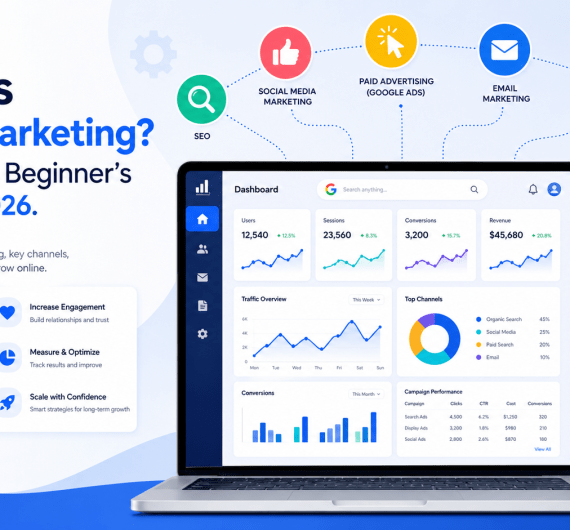
Digital marketing is the umbrella term that covers everything from SEO and social media to Google Ads, email campaigns, content creation, and even AI-powered chatbots. It’s not one single thing — it’s a system of channels and strategies working together.
Why Is Digital Marketing Important in 2026?
If your business isn’t visible online, a large portion of your potential customers simply won’t find you. That’s the reality in 2026.
Here’s why digital marketing matters more than ever:
Online visibility is everything. Over 90% of purchase decisions now start with an online search. Whether someone is looking for a doctor, a software tool, a restaurant, or a CA firm — they search online first. If your business doesn’t show up, your competitors will.
Customers research before they trust. People read reviews, check websites, scroll social profiles, and look for content before they make a buying decision. Digital marketing is how you show up during this research phase and build trust before you ever speak to someone.
Lead generation has gone digital. Cold calling and newspaper ads have a limited reach. A well-placed Google Ad or an Instagram reel that targets the right audience can bring in ten times more inquiries at a fraction of the cost.
Mobile users dominate. Most Indians now access the internet through smartphones. Your digital presence needs to reach people where they are — on their phones, during their daily scroll.
AI search is changing everything. In 2026, people aren’t just googling — they’re asking ChatGPT, using Google AI Overviews, and searching on Perplexity. Businesses that create helpful, structured, well-written content get cited and recommended by these AI engines.
You can track everything. Unlike a billboard or a TV ad, digital marketing gives you data. You know how many people saw your ad, clicked it, visited your website, and converted into a lead. This means you can improve your marketing based on actual numbers, not guesses.
How Digital Marketing Works
Digital marketing isn’t magic — it’s a process. Here’s how it works, step by step:
- A business creates an online presence — a website, social media profiles, a Google Business Profile, or all three.
- People discover the business through a Google search, a social media post, a paid ad, a YouTube video, a blog, or a recommendation from someone they follow.
- Visitors land on a website or landing page where they learn more about the business and what it offers.
- Content builds trust — blog posts, testimonials, case studies, service pages, and FAQs all help the visitor decide whether to take the next step.
- Tracking captures behavior — tools like Google Analytics 4, Google Tag Manager, and Meta Pixel record what visitors do on the site, which pages they visit, and where they drop off.
- Marketing campaigns convert visitors into leads or customers — through a contact form submission, a phone call, a purchase, or a booking.
- Data drives optimization — you analyze what’s working, cut what isn’t, and keep improving over time.
This cycle — attract, engage, convert, measure, improve — is the core of digital marketing.
Main Types of Digital Marketing
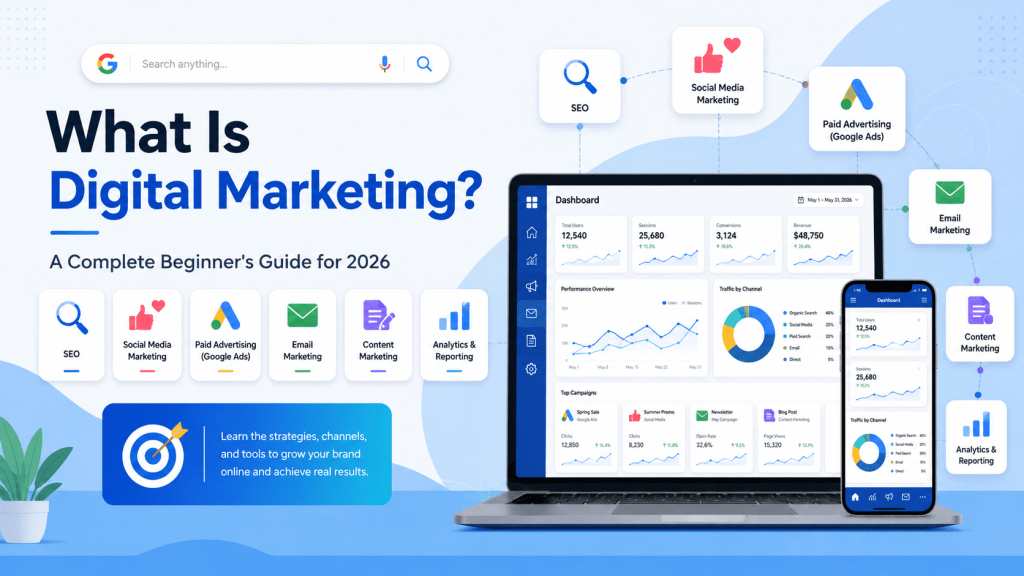
Digital marketing isn’t one thing. It’s a collection of channels and strategies. Here’s a breakdown of the most important ones:
Search Engine Optimization (SEO)
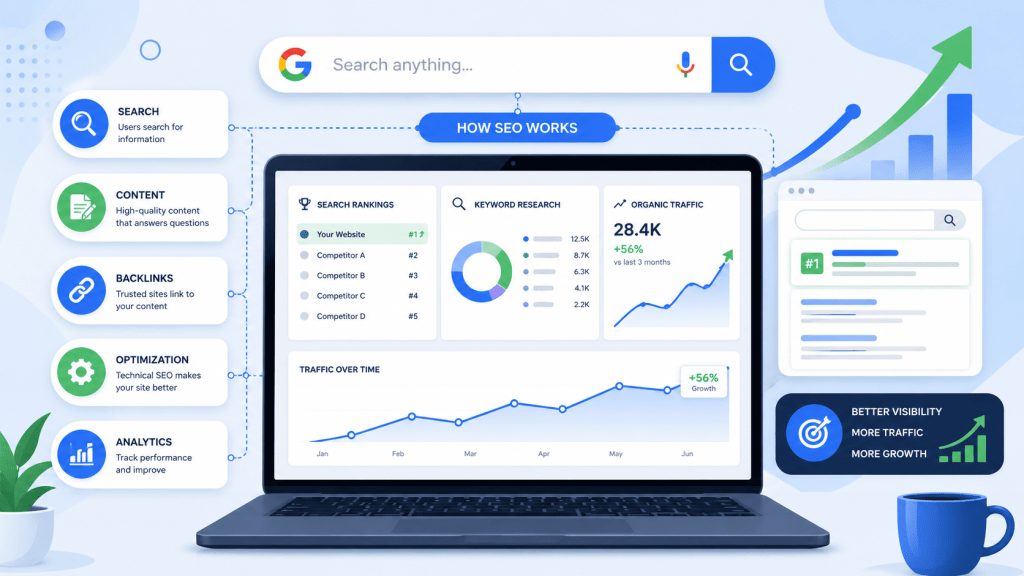
SEO is the process of optimizing your website so it appears higher in Google’s search results — without paying for ads. It involves writing helpful content, building backlinks, improving site speed, and making your pages technically sound. SEO is slower than ads but builds long-term, sustainable traffic.
Social Media Marketing
This includes everything you do on platforms like Instagram, Facebook, LinkedIn, YouTube, and X (formerly Twitter) to build an audience, share content, and engage with potential customers. It’s one of the most powerful tools for brand awareness and community building.
Content Marketing
Content marketing means creating useful, relevant, and valuable content — blogs, videos, guides, infographics, reels, and more — that helps your audience solve a problem. Good content builds trust, improves SEO, and positions you as an authority in your field.
Email Marketing
Email is still one of the highest-ROI channels in digital marketing. It involves building a list of subscribers and sending them targeted messages — newsletters, offers, follow-ups, and updates. When done right, email converts better than almost any other channel.
Google Ads / PPC Advertising
Pay-per-click (PPC) advertising means you pay only when someone clicks your ad. Google Ads lets you place your business at the top of search results for specific keywords. It’s fast, measurable, and very effective for businesses that need leads quickly.
Facebook and Instagram Ads
Meta’s advertising platform lets you reach very specific audiences based on age, location, interests, behavior, and more. These ads are excellent for brand awareness, retargeting, and driving direct conversions — especially for B2C businesses.
Website Design and Landing Pages
Your website is the foundation of your digital presence. A slow, confusing, or outdated website kills conversions. Good website design ensures visitors understand what you offer, trust your brand, and take action.
Video Marketing
Video is one of the most consumed content formats globally. YouTube, Instagram Reels, and short-form content give businesses a way to explain their services, share stories, and connect with audiences in a way text simply can’t match.
Influencer Marketing
Brands partner with creators or influencers who have an established audience in their niche. When done right, influencer marketing can build instant trust and bring in a new, targeted audience.
Affiliate Marketing
Businesses pay commission to individuals or other businesses who refer customers to them. It’s performance-based, meaning you only pay when results happen.
Local SEO
Local SEO is specifically about ranking in local searches — like “digital marketing agency in Delhi” or “plumber near me.” It involves optimizing your Google Business Profile, collecting reviews, and targeting location-specific keywords.
Analytics and Tracking
Tools like Google Analytics 4 (GA4), Google Tag Manager (GTM), and Meta Pixel track user behavior, ad performance, traffic sources, and conversion rates. Without tracking, you’re flying blind.
AI Automation in Digital Marketing
In 2026, AI tools help businesses automate repetitive tasks like content drafting, lead follow-ups, chatbot responses, ad copy variations, and email sequences. AI doesn’t replace human strategy — it amplifies it.
Digital Marketing vs Traditional Marketing
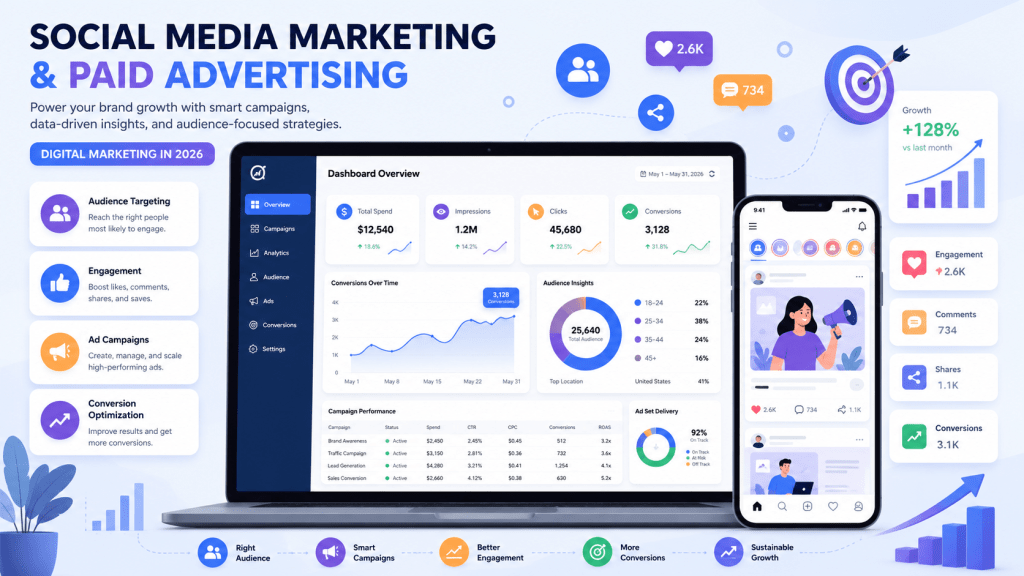
Here’s a simple comparison to understand the difference:
| Feature | Digital Marketing | Traditional Marketing |
|---|---|---|
| Cost | Generally lower | Can be expensive |
| Targeting | Very specific | Broad audience |
| Tracking | Full data available | Difficult to measure |
| Speed | Fast to launch | Slower process |
| Reach | Local to global | Usually local/regional |
| Personalization | High | Low |
| ROI Measurement | Clear and accurate | Often estimated |
| Interaction | Two-way | One-way |
Traditional marketing — like print ads, TV spots, or hoardings — still works in some contexts. But for most small businesses and startups, digital marketing offers better targeting, better measurement, and better ROI.
Benefits of Digital Marketing for Businesses
Here’s what businesses consistently gain from a strong digital marketing strategy:
- More website traffic from search engines, social media, and ads — bringing in people who are actively looking for what you offer.
- Better brand awareness as more people see your name, content, and messaging across multiple platforms.
- More qualified leads because digital marketing lets you target by location, interest, intent, and behavior — so you’re reaching people who actually need your service.
- Better customer targeting so your budget goes to the right people, not a random crowd.
- Lower cost per lead compared to most traditional channels, especially with SEO and content marketing over time.
- Measurable results so you know exactly what’s working and what needs to change.
- Long-term growth through SEO and content that keeps driving traffic for months and years after it’s created.
- Better customer relationships built through consistent social media presence, email communication, and helpful content.
- Retargeting opportunities that let you re-engage people who visited your website but didn’t convert — sometimes all they need is one more touchpoint.
Digital Marketing Examples for Beginners
Still wondering how this looks in real life? Here are some practical examples:
A dentist in South Delhi starts a Local SEO strategy. Within a few months, when someone searches “dentist in South Delhi” or “teeth cleaning near me,” the clinic shows up on Google Maps and the first page. New patient bookings increase consistently without spending on ads.
A home restaurant on Instagram posts short reels showing the food being prepared, real customer reactions, and behind-the-scenes glimpses. The account grows, people share posts, and orders start coming in directly from DMs.
A coaching institute running a Google Ads campaign targeting “best coaching for CA Foundation in Delhi” gets 30–40 inquiries every month. Each inquiry costs a fraction of what a newspaper ad would have cost.
An ecommerce brand selling handmade jewellery runs Instagram and Facebook ads targeting women aged 22–40 who follow fashion accounts. The ROAS (Return on Ad Spend) justifies the budget, and retargeting ads bring back visitors who didn’t purchase the first time.
A business consultant publishes helpful articles on LinkedIn and their website about business strategy, tax planning, and growth frameworks. Over time, people approach them for consulting because the content built trust before any conversation happened.
How to Start Digital Marketing as a Beginner in 2026
If you’re starting from scratch, here’s a practical step-by-step plan:
- Define your goal clearly. Do you want more website traffic? More leads? More sales? More phone calls? Your goal decides your strategy.
- Understand your audience. Who are they? Where do they spend time online? What problems are they trying to solve? The more specific you are, the better your marketing will perform.
- Build a professional website. Your website is your digital home. It needs to be fast, mobile-friendly, and clear about what you offer and how to contact you.
- Create helpful content. Blog posts, FAQs, service pages, and videos that answer the questions your audience is already asking.
- Start SEO. Research keywords, optimize your pages, improve technical performance, and build backlinks over time.
- Use social media consistently. Pick one or two platforms where your audience actually is. Post regularly. Engage genuinely.
- Set up a Google Business Profile if you serve a local area. This is one of the fastest ways to appear in local searches and on Google Maps.
- Set up tracking. Install GA4, Google Tag Manager, and Meta Pixel before you run any ads. You need data from day one.
- Run ads carefully. Once your foundation is ready, test small ad budgets. Learn what works before scaling.
- Improve based on data. Look at your analytics weekly. What’s driving traffic? What’s converting? Double down on what works.
Common Digital Marketing Mistakes Beginners Should Avoid
Almost everyone makes some of these mistakes when starting out. Being aware of them saves time and money:
- Starting without a strategy. Randomly posting on Instagram or running ads without a clear goal wastes effort and budget.
- Posting inconsistently. A social media page that goes silent for weeks loses momentum and trust.
- Ignoring SEO. If your website isn’t optimized, Google won’t rank it — no matter how good your content is.
- Not tracking results. Without analytics, you can’t know what’s working and what’s costing you money for nothing.
- Sending traffic to a weak website. A great ad or a ranked blog post means nothing if the website is slow, confusing, or not mobile-friendly.
- Copying competitors blindly. What works for a large brand might not work for a small business. Build your own strategy.
- Expecting overnight results. SEO and content marketing take months. Even ads need testing. Patience and consistency matter.
- Not understanding your audience. Creating content for “everyone” means it resonates with no one.
- Ignoring mobile users. A website or landing page that breaks on mobile is losing a huge chunk of potential leads.
- Not testing and optimizing landing pages. The page your traffic lands on is just as important as the traffic itself.
Digital Marketing Strategy for Small Businesses
Small businesses don’t need to do everything at once. Here’s a simple strategy that works:
Website as the foundation. Before any marketing, your website needs to be clean, fast, and clear. It’s where all your traffic eventually lands.
SEO for long-term traffic. Focus on ranking for local and niche-specific keywords. Blog content and optimized service pages build organic visibility over months.
Social media for awareness. Consistent, genuine social media presence builds brand familiarity. People buy from businesses they recognize and trust.
Paid ads for fast leads. When you need results quickly, Google Ads or Meta Ads can generate qualified inquiries within days. Use a targeted approach with a small daily budget to start.
Tracking for decision-making. GA4, GTM, and Meta Pixel give you the data you need to make smart decisions rather than guessing.
Retargeting for conversions. Not everyone buys on their first visit. Retargeting ads bring back warm leads and often convert at a much lower cost than cold audiences.
Content for trust. Blogs, case studies, testimonials, and videos show potential customers that you know your industry and that real people have trusted you.
AI automation for saving time. Automate your lead follow-up emails, social media scheduling, and repetitive tasks so you can focus on strategy and client work.
The Role of AI in Digital Marketing in 2026
AI has shifted from being a futuristic concept to a practical everyday tool in marketing. Here’s how it’s being used:
AI content support helps marketers draft blog posts, ad copy, social captions, and email sequences faster. It’s a tool for efficiency — the strategy and judgment still come from humans.
AI chatbots handle website inquiries 24/7, qualify leads, and even book appointments automatically.
AI automation platforms like Zapier and Make connect tools together so that when a lead fills out a form, an email goes out, a CRM record is created, and a notification is sent — all without manual work.
AI search visibility is a new priority. When someone asks ChatGPT or Google’s AI Overview a question, the answer often pulls from well-structured, trustworthy web content. Businesses that create clear, helpful, entity-rich content get referenced.
Personalized marketing at scale is now possible through AI — sending different messages to different audience segments based on their behavior and stage in the buying journey.
The important thing to understand: AI enhances good marketing strategy. It doesn’t replace the need to understand your audience, create genuine value, or build real relationships.
What Is AEO and GEO in Digital Marketing?
These are two emerging concepts every business needs to understand:
AEO — Answer Engine Optimization is the practice of optimizing your content to appear as direct answers in Google’s featured snippets, People Also Ask boxes, and voice search results. When someone asks a question on Google and a direct answer box appears at the top — that’s AEO at work. Businesses that write clear, structured, question-answering content benefit most from this.
GEO — Generative Engine Optimization is about making your content visible and citable in AI-powered search engines like ChatGPT, Google Gemini, Perplexity AI, and Google AI Overviews. These platforms summarize information and recommend sources. If your content is well-written, factually sound, and clearly structured, AI systems are more likely to pull from it.
Why does this matter? Because in 2026, a significant portion of information searches happen through AI tools. Businesses that optimize for both traditional search engines and AI engines will have a major visibility advantage over those that don’t.
The good news: AEO and GEO don’t require completely separate strategies. Creating genuinely helpful, well-organized, human-written content naturally performs well across both.
How Skyhoora Helps Businesses With Digital Marketing

At Skyhoora, we work with small businesses, local service providers, startups, and ecommerce brands to build digital marketing systems that actually generate results — not just impressions.
What we help with:
- Website design that’s fast, professional, and built to convert visitors into inquiries.
- SEO to build long-term organic traffic from Google — local and national.
- Social media marketing with consistent, on-brand content that builds real audience engagement.
- Google Ads campaigns designed for qualified leads, not just clicks.
- Facebook and Instagram Ads with proper audience targeting, creative testing, and retargeting setups.
- Tracking setup — GA4, Google Tag Manager, and Meta Pixel — so every decision is backed by clean data.
- Branding that makes your business look credible and trustworthy from the first impression.
- Content creation — blogs, social posts, ad copy, and website content — written to rank and convert.
- AI automation to save time on repetitive tasks and scale your marketing workflows.
- Complete digital growth systems that bring all these pieces together into one coordinated strategy.
We don’t sell packages. We understand your business first, then build a strategy that fits your goals and budget.
Digital Marketing Is No Longer Optional
A few years ago, a business could survive on word-of-mouth and a basic website. That’s harder now. Customers expect to find you online, read about you, check your reviews, and decide whether to trust you — before they ever call.
Digital marketing is how you show up for that decision.
The good news is that you don’t need a massive budget to start. You need clarity about your goals, a basic understanding of how the different channels work, and the patience to be consistent. Results take time — but they compound. A blog post written today can bring in leads twelve months from now. An Instagram account built consistently over six months can become your primary lead source.
Start where you are. Build your foundation. Track everything. Improve steadily.
If you’d like help building a digital marketing strategy that’s right for your business, Skyhoora is here to help. Whether you’re starting from zero or want to optimize what you already have, we’ll work with you to build something that lasts.
Frequently Asked Questions (FAQs)
1. What is digital marketing in simple words?
Digital marketing is using the internet — through websites, social media, search engines, email, and ads — to reach, engage, and convert potential customers. It’s how businesses grow their visibility and sales online.
2. Why is digital marketing important in 2026?
Because most people search for products and services online before making a decision. If your business isn’t visible online, you’re missing a large portion of potential customers. In 2026, AI-powered search tools add another reason — businesses with well-structured online content get recommended by AI engines as well.
3. What are the main types of digital marketing?
The main types include SEO, social media marketing, content marketing, email marketing, Google Ads (PPC), Facebook and Instagram Ads, video marketing, influencer marketing, affiliate marketing, local SEO, and analytics and tracking.
4. Is digital marketing good for small businesses?
Yes — digital marketing is especially valuable for small businesses because it offers targeted reach, measurable results, and lower costs compared to many traditional channels. Local SEO and social media, in particular, can produce strong results even with a modest budget.
5. What is the difference between SEO and digital marketing?
SEO (Search Engine Optimization) is one component of digital marketing. Digital marketing is the broader term that includes SEO, paid ads, social media, email, content, and more. SEO specifically focuses on improving a website’s visibility in organic (unpaid) search results.
6. How long does digital marketing take to show results?
It depends on the channel. Google Ads can generate leads within days. SEO and content marketing typically take 3–6 months before significant results appear. Social media growth usually builds over consistent months. Overall, digital marketing is a long-term investment that rewards consistency.
7. Can beginners learn digital marketing?
Absolutely. Digital marketing is learnable at any stage. Many free resources are available online, and most tools are beginner-friendly. Starting with one channel — like SEO or social media — and expanding gradually is a practical approach.
8. Which digital marketing channel is best for beginners?
Social media marketing and SEO are often the best starting points for beginners. They require low initial investment and help you develop a foundational understanding of how online audiences work before spending money on paid ads.
9. How much does digital marketing cost?
Costs vary widely depending on your goals and channels. Social media marketing and SEO can be started with a modest budget. Paid ads like Google Ads or Meta Ads can start from ₹5,000–₹10,000/month for testing. A full-service digital marketing strategy depends on the scope of work and agency involved.
10. How can a business start digital marketing?
Start by defining your goal, building a professional website, setting up a Google Business Profile if local, creating helpful content, and establishing a presence on one or two social platforms. Install tracking tools early. Once your foundation is ready, consider SEO or paid ads based on how quickly you need results.